Final theory for the Umineko question arcs:
Endless Speculation
Welcome, to our final theory. This is our magical compendium. This is our Golden land.
With this work we aim to present the full extent of our understanding of the physical and the metaphysical elements at the foundation of this story once and for all.
I am Crunter the writer, and lead theory-crafter.
and I am Hound Dogs, co-writer, editor, and creator of this site.
We will be presenting our ideas and interpretation in a very matter of fact style, but we won't shy away from bringing up instances where we are not certain of something.
Let's start from the very beginning.
Part 1: Beatrice, and the past
Let's answer the greatest question first. What is Beatrice?
As a witch, Beatrice holds two titles: "Golden" and "Endless".
These originally came from separate Magical Compendiums, so it can be said she wields the power of two compendiums.
———
The title of Endless Witch has its foundation in "Endless Creation" and is the root of her unmatched, endless magical power.
The title of Golden Witch has its foundation in "the Realization of Magic", a magical power that can materialize imaginary precious metals, providing the miracle of manifestation to all less tangible forms of magic.
———
These two titles were refined even further with Mariage Sorcière leading to their sublimation into the compendium known as "Endless Realization".In that sense, she technically shouldn't be referred as either the Endless Witch or the Golden Witch, but by a new title that is a fusion of the two.
———
~ Beatrice's Titles
"Magic in Umineko is the act of holding and perpetrating beliefs." A significant part of this chapter will be dedicated to developing the groundwork to justify this statement, and to explain "Endless Realization".
Saying that Beatrice holds these titles is saying that she's the "head" of both the Golden magic, and Endless magic narratives at the same time.
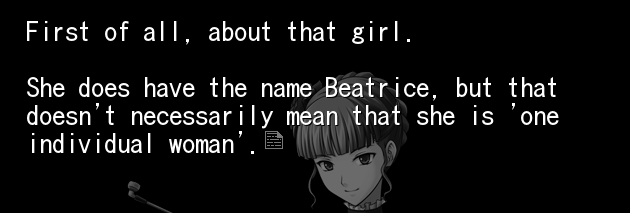
But, as Bernkastel pointed out, she is not "one individual woman", and the figureheads of the two compendiums haven't always been the same over the years.
The Golden witches
Alpha Beatrice
At some point after the second world war, some lady gave Kinzo access to a vast amount of gold, and Kinzo fell desperately in love with her. Given his knack for the occult, he would then frame her as an all powerful witch.
We'll call this woman Alpha Beatrice.
We went back and forth trying to decide if we should call her the first golden witch or exclude her by technicality. She sealed the original deal with Kinzo and would have had the rights to his fortune, but unlike her successors she isn't a witch of Kinzo's creation.
Either way, she served as the inspiration for the branch of the Golden magic.
Do the 10 tons of gold really exist? Banquet of the golden witch makes it really difficult to dismiss it as nothing but pure misdirection. Both Eva and Rosa get to see it in a scene that isn't overtly magical.
That being said, it's very conceivable that what Alpha gave Kinzo was just a starting capital to enter the world of business, and Kinzo amassed the rest of the wealth over the years.
Even if the gold does exist, that amount is not easy to move, sell, or utilize. What this funding really did was giving Kinzo chips to gamble with. He used the rumors around the gold as a buy in to access the business world and succeed in it, until he really became a multi billionaire and restored the name Ushiromiya to the importance it had lost after the war.
Truly, "a magical power that can materialize imaginary precious metals".
Alpha Beatrice eventually died some time before 1952 under circumstances as of yet unknown.
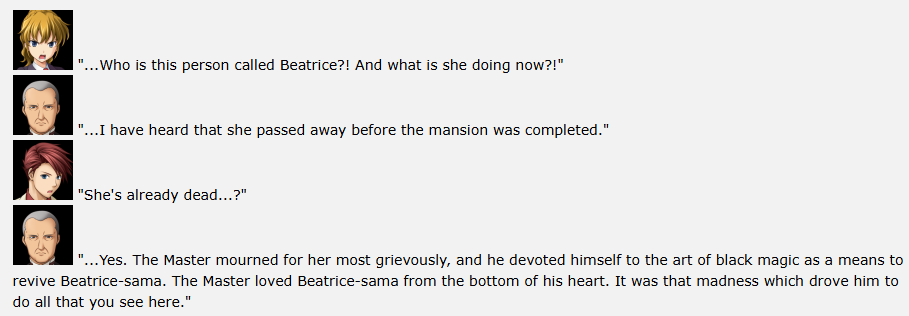
Kinzo was distraught by this fact, and he became deeply obsessed with the myth of the witch he had created, so much so that he came up with an idea to "resurrect" her.
X Beatrice
With Kinzo mourning his beloved for the second time, the supply trips to Kuwadorian stopped completely.
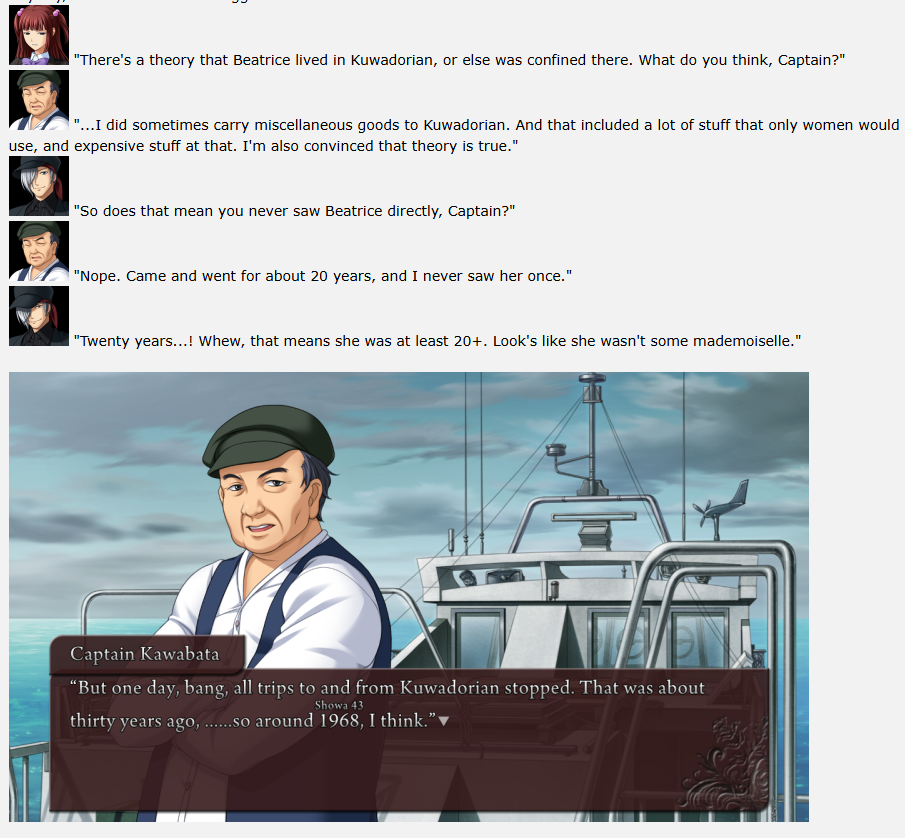
Nobody was living there anymore, and according to Beato's magical reconstruction, her soul was reduced to golden butterflies without a vessel permeating the air of Rokkenjima.
It would seem for all intents and purposes like Kinzo had given up on the project, but this wasn't the end. He eventually came across another child with unusual western traits, blue eyes, and golden blonde hair just like his beloved witch. We believe she was an orphan at Fukuin house, the orphanage he founded where the younger servants are raised.
This girl is our mysterious 19th person X, and since she doesn't have a name either, we deem it fitting to call her X Beatrice.

In Turn of the Golden Witch she is the woman who Rosa sees with Maria, and Kyrie says she talked to (she does appear in more scenes, but those are the only reliable ones for reasons we will not explore now).
In Alliance she makes another appearance as the person who talks to Battler from the balcony at the entrance of the mansion.
We think she exists as her own entity because the way she is shown and described visually distinguishes her from the usual Beatrice. We'll later go to greater lengths to justify her, doing so now would be premature.
X is very likely the model for the witch's portrait that was hung in the hallway with the epitaph two years ago. Multiple people comment on her looking exactly like the painting, and although Rosa said the same of the "witch of the forest" she met all those years ago, it's reasonable to assume she only remembers her most striking features like the eyes and hair. Most likely, Rosa just filled in the details in her memory when she saw the painting, after being conditioned to expect Beatrice.
Although we're calling her X Beatrice she didnt become Beatrice right away, because of course Kinzo learned a lesson from the experiment with 0, and he understood that raising a secluded child like that is risky and unsustainable.
The family was suspicious, and rumors were spreading about someone else living on the island, if you then consider that X would have been be older than 0 Beatrice was at the time of her confinement, it just made more sense to raise her in the orphanage.
It's still a controlled environment, but far away from Rokkenjima, and through the hidden harbor she could still periodically visit Kuwadorian, or even the main mansion itself.
Perhaps because of this less sheltered upbringing, we think X came to strongly resent Kinzo's expectations. In his eyes she was supposed to eventually fulfill the role of Beatrice like her predecessor, but the resurrection wouldn't be complete until then.
The people in Rokkenjima that know about X's existence are the servants and Nanjo, who served as her doctor since she had to remain secret.
During one of the the family conferences in 1980 somehow Battler accidentally met X, and in that instance he made some kind of promise to her.
To Battler, the promise had no real weight, and he would forget it in the six years that he spent away from the family.
But to X, it was really important, and him forgetting it will eventually break her heart.
Kinzo's Furniture
Beyond Kinzo's Beatrice project, another aspect of golden magic can be found in the servants that Kinzo calls his furniture. After all, they're his property, an extension of his wealth.
His grip on them is so strong that he can forge them new identities.
The kids from the orphanage are given names that override their own when they become servants, of which Shannon and Kanon are two examples.
Likewise, although we know almost nothing about Genji's relationship with Kinzo in the past, we can see he's fully devoted to his role as furniture and has been shaped by it.
Golden magic
The title of Golden Witch has its foundation in "the Realization of Magic", a magical power that can materialize imaginary precious metals, providing the miracle of manifestation to all less tangible forms of magic.
Overall, we can identify the golden magic branch as Kinzo and Beatrice's absolute authority over all things that belong to the Ushiromiya family head. This power lets them turn false objects or even people into reality by simply flaunting wealth and status, be it real of perceived.
The objects of the magic include the gold, Beatrice herself, the servants, as well as the mansion and the whole island. Likely even Kinzo's heirs (see the first of Beatrice's letters in legend). More or less everything and everyone that was on the island at the time of the tragedy.
As more proof that the golden magic is strongly associated with the headship of the family, we know that the servants are taught to treat Lady Beatrice as the second master of Rokkenjima, who must be treated with the same respect as Kinzo.
The Endless witches
Now that we have half of the puzzle figured out, we can move on to the more elusive "Endless" branch of Endless realization.
We can start to define what this branch is by pointing out what it is not.
The adjective "Endless", as far as we're aware, is never mentioned by Kinzo or any other distinctly human character next to Beatrice's name, it instead features prominently in the tea parties as her main title since as soon as Bernkastel's first appearence at the end of Legend.

The reason for this is quite simple, Endless magic has nothing to do with Kinzo's legend of the witch, but it originates from the coping mechanisms of the servants working under him.
Alpha Beatrice
Why is she here? Is she not the origin of the Golden magic branch?
Well, yes, but that was Kinzo's side of the story. Now, let's put ourselves in her shoes instead, having to deal with Kinzo's unrequited love, and having to watch him mistreat his servants, his children, and really anybody he considers his property.
We don't know if Alpha herself was a servant, but we hypothesize that, to them, she was either an empathizing companion or a caring master, perhaps both at the same time, and the Endless magic is her attempt to defend them from the harshness of the Ushiromiya head.
Admittedly, this claim is not based on very solid evidence. All we get in terms of a backstory for the Endless branch is Virgilia's flashback in the prologue of Banquet, and in that she mentions that she herself had a master who taught her magic.
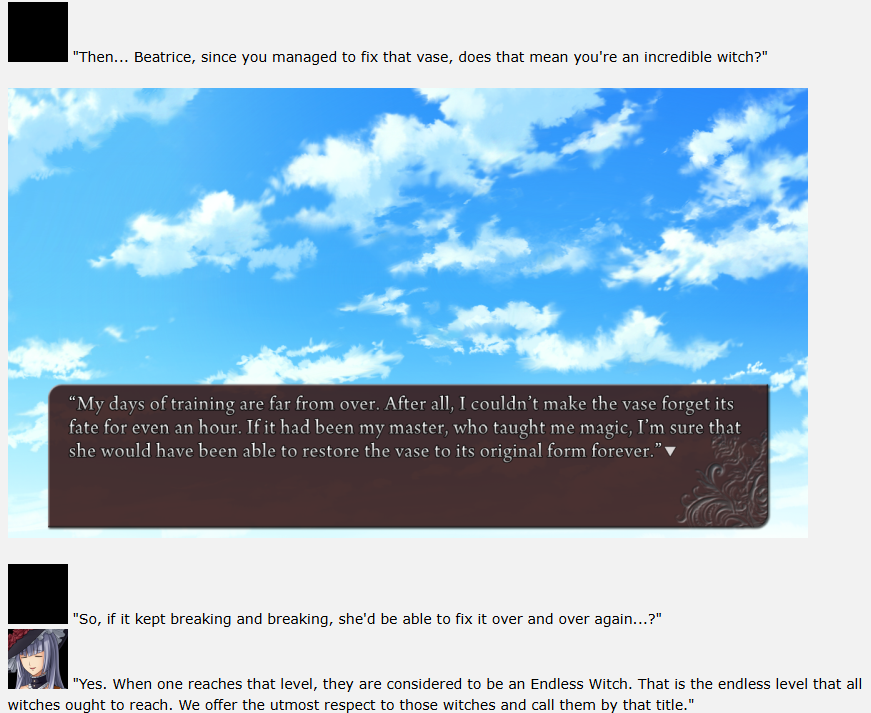
This master could be anybody, it doesn't have to be Alpha, but in trying to fill in the gaps we will go with the option that is the most thematically fulfilling, while also minimizing the number of unknown characters we need to introduce.
So. Alpha Beatrice was an Endless witch. Not necessarily the first endless witch, as the tip "Regarding the Succession of Witches" hints at a long lineage, but she is the first we care about.
Furthermore, during the story, Beatrice inherited that name along with the position, but that is a very recent innovation. The Predecessor was the original Beatrice, and all Endless Witches before her had different names. After that, it became customary for the name to be inherited as well, and EVA Beatrice followed that tradition when giving ANGE the name of Beatrice.
This paragraph is very confusing, because it seemingly introduces a contradiction. The predecessor it mentions is almost certainly Virgilia, and it's impossible for her to be Alpha because she died too early to interact with the young girl in the flashback, whoever she may be out of all possible candidates.
This leaves us with the most plausible explanation being that Alpha never called herself Beatrice at all, and it's a name given to her by Kinzo.
Either that or Virgilia's teacher isn't Alpha after all.
Virgilia
The equivalence Virgilia = Kumasawa is hinted to in the text very clearly, it is functionally spelled out loud. If her bursting out of Kumasawa in Banquet isn't enough evidence, shall we point at the mackerel joke?

Kumasawa is the oldest servant of Kinzo, and would have been a young maid when Alpha Beatrice was still alive. It's through this connection that she was taught the ropes of her magic.
Now that she is older, she acts as a motherly figure towards the younger servants, many of whom are orphaned children from Fukuin's house. She playfully calls herself Beatrice in front of them, teaches them the ropes of the job, and as her master once did for her she also teaches them how to deal with the difficult and not always agreeable members of the Ushiromiya family.
Let's zoom in on a certain clumsy young servant, who is predictably bad at her job, and frequently damages and breaks things, as any child would. This servant is Sayo, the real name of the furniture named Shannon.
This flashback below shows us an example of Kumasawa teaching Sayo the techniques of the Endless magic, a way to make your narrative a reality regardless of what originally happened.
After Sayo breaks a vase, Kumasawa "fixes it with magic".
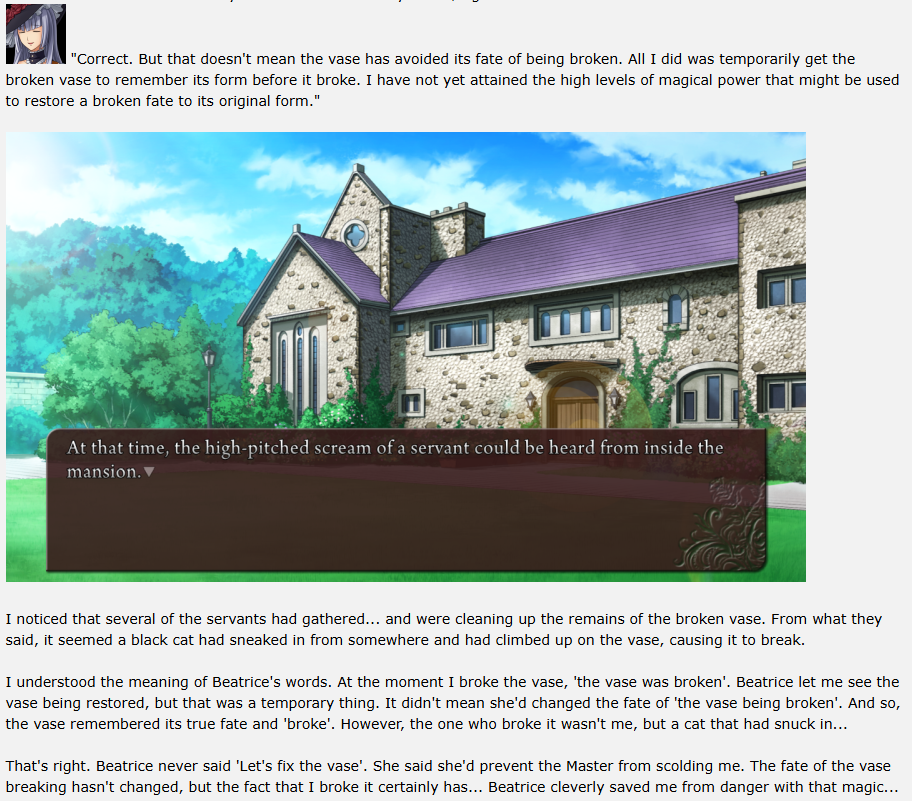
In truth we can reconstruct that she simply talked to the other servants and convinced them to testify that the vase was broken by a cat.
This is pretty much all there is to it. Endless magic, at its heart, is telling white lies and cooperating to uphold them. It's a shared narrative that people believe and practice together, and if the magic is internalized as real it can in turn influence the world.
This approach can be applied to more than just a trick to not be blamed for your mistakes, it can also be a form of escapism to help people cope with the reality of their situation.
Sayo
From the tea party of Turn we get this description of Shannon.
Shannon is, in the truest sense, Kinzo’s handmade furniture, which he created without borrowing the power of demons.
Though there were a few problems with her initial specifications, she was given a very rare and precious thing: a heart.
It seems that, as a result of his long personal experience, Kinzo came to believe that the power created by the heart contains
In the lengthy span of time following that, she began to mature, becoming exceptionally skilled with powers of a protective or repulsive nature, such as magical barriers.
Because of this, in the realm of barriers alone, she possesses immense, magician-class power.
~ Shannon's description in Episode 2 (outside the gameboard)
We already mentioned how Kinzo sees his servants as his own property and creation, and these descriptions imply a lot of his influence in the education of these kids, but the part about magical barriers also hints at Sayo's affinity for protecting her peers. She is the perfect person to inherit Kumasawa's role and her Endless magic.
However, a few years after Shannon, another orphan was hired as a servant and given the furniture name of "Kanon".
We believe that Kanon, like Shannon, is also Sayo, just wearing different clothes.
This insight is one of the most important keys to make sense of the events in Rokkenjima. It's what explains the inconsistent number of people on the island.
Why take on this new identity though? We don't quite know for sure. Most likely Kinzo's input had something to do with it.
So far, he is the last furniture created by Kinzo.
Making use of all his previous experience, Kinzo managed to implement a set of flawless specs. Kanon was also given a heart, but it was much weaker than Shannon's.
Perhaps because Kinzo felt a sense of approaching personal danger related to his fortune as he neared the end of his life, he bestowed Kanon with the rare power to fight and protect.
However, he hasn’t yet matured very far and is unable to properly control his own power and speed.
———
~ Kanon's description in Episode 2 (outside the gameboard)
This is an aspect of the Golden magic. Kinzo can just decide to impose a new identity on a servant, and in the case of Shannon and Kanon, all it takes is a wig and different clothes to turn into someone else.
We are very well aware that a piece of the puzzle is missing here.
Sayo seems very involved in the two identities. It's not like she's putting up with it because she's forced to. We're also not too sure why Kinzo would go out of his way to impose this on one of his servants, but Kanon and Shannon both being Sayo explains so much to make these missing details not enough to discard the insight as a whole.
All the servants on the island know about this. Genji is absorbed by Kinzo's narrative, Kumasawa doesn't really have the ability to do anything about it, and Gohda, when he eventually starts working on Rokkenjima, desperately wants to keep his job, so he puts up with it. The other servants we never see also presumably know.
X, who is another of the orphans, and Sayo are both living quite miserable lives growing up. One is being indoctrinated to eventually become "Beatrice" and couldn't care less about it. The other is a child servant of an extremely abusive family, she has worked for them since when she was six years old, and she too is getting her identity engineered by the patriarch.
Sayo, as a servant, often takes care of X and the two are very close. X is aware that that Kinzo's magic isn't "factually" real, but she's used to treat it as such, and Sayo's endless magic represents the positive side of the "magical" coin.
In this version of the world shared by just the two of them, Beatrice is a kind Endless witch embodied by Sayo instead of the Golden witch that she is being burdened with.
Another benefactor of the Endless magic is Maria, who Sayo can easily empathize with. At one of the family conferences she shows the concept of Endless magic to her, and Maria is immediately charmed by it.
The title of Endless Witch has its foundation in "Endless Creation" and is the root of her unmatched, endless magical power.
Mariage Sorciére
Sayo and Maria, with Kumasawa watching over them, spend the days of the yearly conferences talking about witches and how to use magic as a positive force in the world to make people happy.
The inclusion of Maria's creativity will transform their little game into a richer narrative and introduce in Beatrice's setting such colorful characters as Virgilia, Ronove, Gaap, the stakes of purgatory and the Chiester sisters. This is Mariage Sorciére, the little garden of Maria and Sayo.
An alliance of witches formed by lady MARIA, the Witch of Origins, and lady Beatrice, the Endless Witch. Together, they created a groundbreaking magical compendium, which brought about immense influx of strength to Beatrice's once-declining magical power.
It's probably safe to say that the formation of this alliance allowed Beatrice to gain the endless power in its truest sense.
———
~ Mariage Sorcière
This setting is steeped in demonology and occult rituals because Maria was also influenced by her grandfather and developed a strong interest in the occult. It's possible she couldn't grasp the distinction between the Golden and Endless aspects of Beatrice's magic, or she chose to incorporate both in their creation. Regardless, the two branches are now united in "endless realization".
These two titles were refined even further with Mariage Sorcière leading to their sublimation into the compendium known as "Endless Realization".
———
~ Beatrice's Titles
X is not part of this alliance, after all her existence is a secret, but if her story is anything like the one we told, she might not have been too keen on playing witches.
We don't think she and Maria ever actually met, not before the day of the murders anyway, but if they were to meet on that day she would recognize her from the portrait. After all Beatrice is extremely well versed in magic, what reason would the young apprentice have to doubt that she was seeing her master's true form?
In practice, this means that for Maria meeting either Sayo or X during the games counts as having met "Beatrice".
An Occam's razor aficionado could point out that our Sayo and X Beatrice have suspiciously similar backstories, but we tried merging them into one person, and it doesn't really fit well.
Later on, near the end of the theory, after we're done explaining all the events, we'll build a stronger argument for why they make more sense as two separate people, so let's move on for now.
The downward spiral of the Black witch
As the years pass and the children grow up, things don't improve for any of them. Escapism is not really a long term solution to living in an unhealthy environment, and all three of Maria, Sayo and X reach a breaking point.
We know all the details of Maria's struggles from the many scenes in Alliance of Ange reading her diary. She's suffering because she feels like a burden for her mother, who's under immense amounts of financial and societal pressure and is starting to become abusive.
In order to cope with this, Maria uses the magic she learned from Sayo.
"Black witch" or black magic is a catch all term for people who act violently or abusively in order to cope with one's situation. The name is introduced as a way for Maria to rationalize the bad part of Rosa's personality, but later on the same framework is adopted by Ange, who applies it to Eva, Kasumi, and Beatrice herself.
Speaking of Ange, during the 1985 family conference, the last one before the tragedy, Maria tries to teach her about their magic and briefly admits her into the alliance... but, as you might expect from a 5 year old, Ange doesn't take it very seriously. She only sees it as a game, she makes fun of Maria's fantasies, and in an act reminiscent of her brother she denies magic.
Young Ange did receive an invitation to join this alliance at one point, but she was later excommunicated.
~ Mariage Sorcière
An insinuation of her happiness being just a lie is the last drop for Maria, who starts wishing pain, not happiness, upon others. This is perfectly exemplified by the Chiester sisters characters, originally based on Maria's rabbits figurines that Rosa had gifted her, and now corrupted to represent winchester rifles in the new Mariage Sorciére.
Meanwhile, Kinzo is becoming old. His children didn't live up to his expectations and he wants to find a method to settle the inheritance problem in a way that benefits the most worthy, in his eyes of course. He commissions the portrait of X, and places an epitaph below it with a riddle that leads to his gold.
We're sorry to say that we have not solved the riddle. Not even close.
Not long before the murders of Rokkenjima, Kinzo orchestrates a resurrection ceremony for Beatrice. She is horrified by this, she doesn't want to be that, so a sequence of events transpires at the end of which X murders Kinzo by shooting him in the head.
We think she's the culprit because of this screen in Banquet, where, considering that the Beatrice wearing this outfit doesn't appear anywhere else in the episode, a plausible reason that comes to mind to show this version of the portrait over the regular one is that it's meant to be a hint.
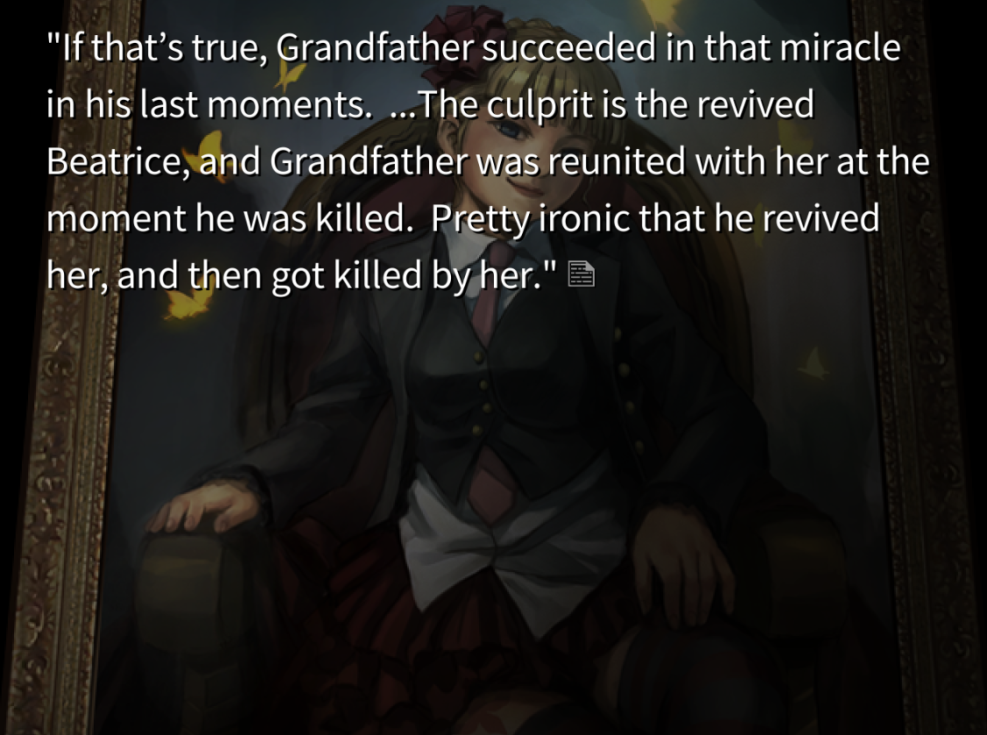
The dynamics of how it happens are not clear to us... but she does have a motive. Kinzo has treated her like a token, projecting his machinations onto her. She should have more than enough reasons to hate him.
For all we know, Kinzo might have even met his end willingly, but there really isn't much to go off of other than this paragraph at the beginning of Legend.
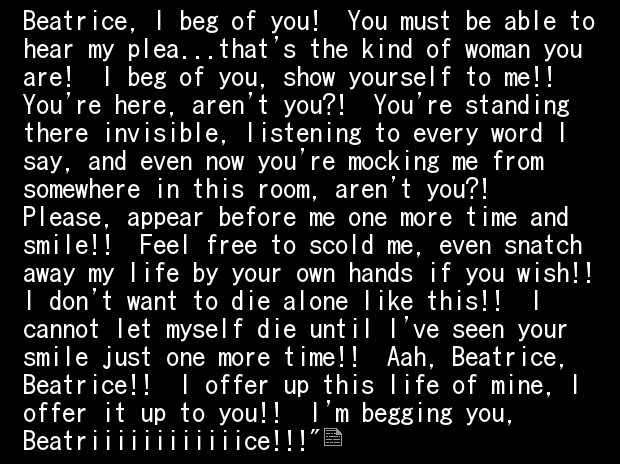
With the help of the other servants they hide Kinzo's body after taking the family crest ring. Probably not much mourning was done except by Genji, the only person that truly cared about Kinzo... But to him all is according to the plan. After all, the Golden witch Beatrice has just began fulfilling the terms of the contract by taking what was owed to her.
As awful as Kinzo was, as abusive as he was, suddenly, X is but an orphan with no caretaker. The only people who even know of her existence are the servants and Nanjo. She is no one, just an anonymous person X.
She might have regained some freedom, but she has no prospect for the future. It's very likely that if Kinzo's children were to know about her she would be seen as a serious threat to their heritage.
Luckily Krauss, fearing his embezzlement to be revealed, conspires with the servants, Nanjo, and his wife, to pretend that Kinzo is still alive for the time being. This preserves the status quo, but an investigation by the other siblings into the assets of the family might end up revealing her existence. Being in such a precarious position she hides away in Rokkenjima biding her time.
X is spiraling. Kinzo ruined her life, she has but one close friend, and the one person that made her a significant promise, Battler, disappeared from her life.
Eventually, Sayo does something that majorly shakes the status quo. She solves the epitaph.
This is a bit sudden and unexplained. We are filling a hole here, but from later on, it's clear she has access to an important amount of money. Let's say that her close ties with Kinzo and X gave her access to some important information that the rest of the siblings lacked.
With access to an astounding amount of money Sayo has, in theory, the ability to bring her and X out of this mess. Except... it's not that easy.
Compared to the other two girls Sayo is not doing much better. She lives a double life and all she has is a job where she's treated miserably and she doesn't even feel like a real person.
Shannon and Kanon's worldviews drift further apart, with Shannon's more hopeful outlook on the world seeming more feeble, while Kanon's more grim and realistic one becoming stronger.
A point of contention between them becomes what to think of Sayo's third aspect, the Endless witch. This is fundamentally what the beginning of Episode 2 is about, a struggle between the part of Sayo that is becoming disillusioned with magic and can't wish for a better world anymore, and the one that still sees magic as a beacon of hope.
With the sublimation of the Golden magic into the Endless, she manifests the wishes that she was contempt with just imagining before, and so, unlike Virgilia, the Beatrice shown in those scenes has clear Golden witch elements, like her appearance and the sassy witch persona.
At this point Sayo, having solved the epitaph, considers running with the gold, but she decides against it. She, like X, doesn't have a model for what happiness looks like, and doesn't know what to do with all that wealth.
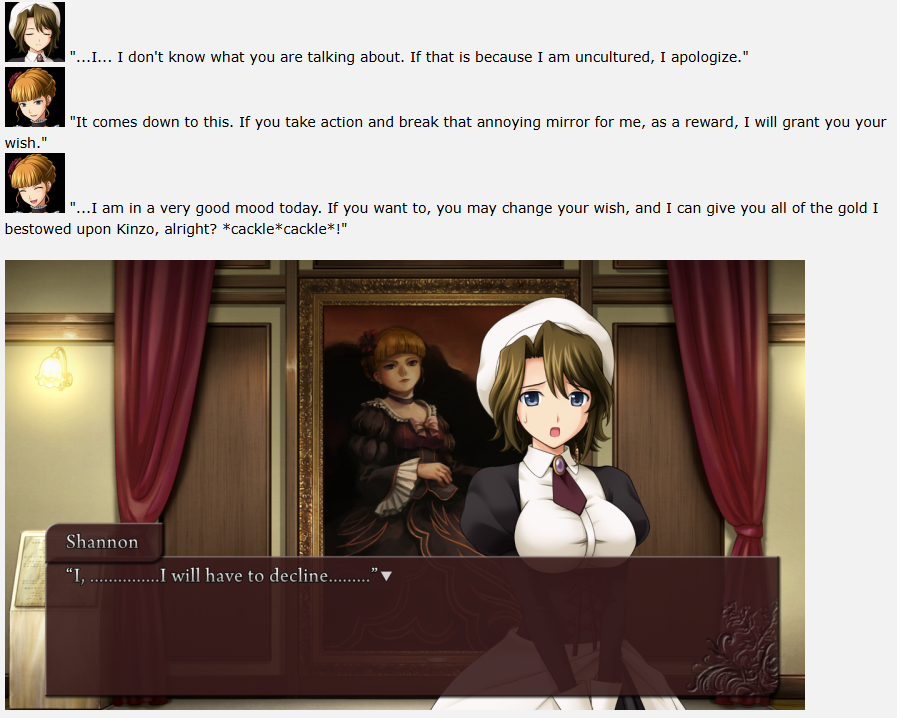
In the end "Shannon" breaks the mirror and begins a relationship with George after receiving the golden butterfly brooch.
As the description almost states outright, this is pure placebo, but for the Endless witch to work her magic she needs a story she can tell herself.
This object arranges all fate variables in a favorable manner to form relationships between the sexes.
This leads to nothing more than a favorable arrangement of variables, so its strength differs widely depending on the individuals in question.
Hence, a witch bestowing such an item must make quite sure beforehand that the receiver will be able to use it effectively, or she risks being called a liar. The activation cost is enormous, so it’s no more useful to the average person than an ordinary brooch.
However, blind love is easily capable of paying this enormous price. And, if the target of the receiver’s affection feels affection in turn, the brooch’s effect increases even more dramatically.
Ironically, the more dramatic its effect becomes, the less one would need such a brooch in the first place.
Why does she suddenly pursue George? In her mind he's the fantasy of a way out of her situation. He's the first person from outside the servants group that seems to show interest in her, and she projects on him her desire for personhood. She thinks that love is what can pull her out of her misery
She starts dating him, but it becomes really clear really quickly that he is immature, somewhat childish, and more importantly not really what she is looking for. She grows increasingly disinterested, and once again she's left with nothing.
It's very relevant that in the scene when Shannon breaks the mirror, the scene in which she commits to break away from the prison of her situation, his name doesn't come up once.
However, there is someone else with whom she's developing a much stronger connection, but to make it work she needs her Kanon persona.
She sets up a date between Jessica and Kanon, and she ends up enjoying it much more than expected. Seeing Jessica act true to herself shows her what she wants... but that still seems unreachable at this point.
After the events of the school festival, Jessica's confession to Kanon scrambles her system, she obviously can't accept, among other reasons because Jessica is in love with "Kanon", which she believes to be a man, not with her.
Sure, she is dating George, but that too isn't working out. He's so clueless that he proposes to marry her at the age of 16 without even truly knowing anything about her or about her situation. At this point, in her mind, she has completely abandoned that lifeline.
Sayo starts spiraling as well, and Beatrice becomes an increasingly dark element in her fantasy, so we see her acting more and more hostile towards the two servants. Despite her best efforts she still can't stop feeling like furniture and is unable to turn around her situation.
Part 2: The gameboard
We have almost made it to the start. What follows is our reconstruction of the events that lead up to the family conference of 1986.
The motive
Given how badly things are going for everyone... Sayo has become desperate. She feels misunderstood, she feels lost, she feels like she's not a real person, only furniture. More than anything else, she feels deeply unseen, and the only people really close to her, at this point, are doing even worse.
X is also the husk of a person. She has lost her will to live and feels so hopeless that she's becoming suicidal. The only hope left to her is the mysterious promise Battler made.
Maria has the whole situation with her mother, and she's finding it increasingly difficult to stay convinced of her own magical narrative.
The one ace up Sayo's sleeves is access to all the hidden gold. She could use it to bring happiness to everyone... but she chooses not to. Instead, she constructs a much darker, much more elaborate plan.
She might now know how to reach happiness... but she knows who to blame . She knows who is responsible for the awful situation she and everyone she cares about find themselves in.
It's Kinzo's children and their spouses, who are complicit in abusing the servants and Maria.
It's Nanjo, for knowing of the situation, and never speaking up about it.
It's the other servants, for allowing all of this to happen. Godha is too cowardly, too afraid to lose his job to ever say anything, Genji is completely subservient to Kinzo's wishes, and Kumasawa, while being the closest thing to an ally, was never truly trying to get them out of this mess.
Lastly it's also Kinzo's grandchildren. Every single one for them has been involved with her and X's disillusionment. George is a failed, disappointing, attempt at happiness, Jessica is the symbol of an happiness that is forever out of reach, Battler and his forgotten promise are symbols of false hope, and Ange denied the reality of their golden land when it was still a happy place.
Only Maria is a victim just like them, and so she is spared from the Judgement.
Sayo decides that death is the only punishment that everyone involved deserves. After all, if there is no hope in reality, magic is the only realm in which people can find true happiness, true fulfillment. The hell of Rokkenjima is a hotbed of suffering and hurting, and she decides to resolve that situation in the same way she did when playing with Maria. With magic.
But, this time it's not a benign fantasy, it's an obsessive revenge plot modeled after the sacrificial ceremony described in the epitaph.
Sayo decides that on the day of the family conference she'll end the lives of every single one of the people in Rokkenjima, the three victims alongside everyone else that she deems responsible. It's only by sheer luck that Ange gets sick and can't attend the conference, or she would have suffered the same fate as everybody else.
With the power of her endless magic, she will obscure the material events of Rokkenjima, and create a fictional narrative where at the end of the ritual everyone is resurrected in the golden land.
As long as the events remain hidden and her side of the story becomes publicly known instead, it will become the "truth".
She is filled with resolve. She is filled with certainty. But thatalmost wavers when X isn't fully convinced. It seems she is still clinging to one last hope. That year Battler is supposed to attend the family conference for the first time since he made the promise.
X agrees to the plan, but at the condition that if by any chance Battler is still serious about it, then Sayo will call it off.
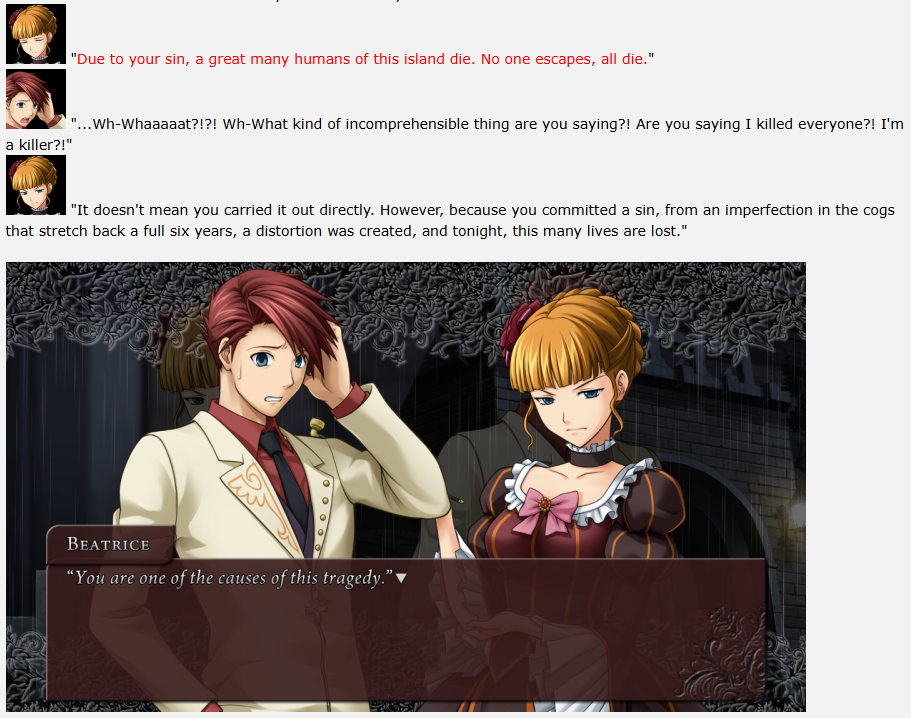
Maria is also vaguely aware of what's going to happen, she is never surprised when the murders begin and she fully believes that everyone will be resurrected at the end, but she isn't given any details of the plan and never directly helps in committing a murder in any of the scenarios. Despite everything, they don't want to put this burden on a child.
The ritual
Sayo arranges for the island to be cut off from the outside world. She identifies which wires to cut so that the phone won't connect to the mainland and ensures there are no boats they can use to escape.
This means she will have to prepare everything she needs beforehand, hardly something she and X could do alone and in secret. Plus, as is often pointed out in the debates, it would be almost impossible for one human to successfully carry out all the murders without anybody on their side, so she needs to gather some allies.
The accomplices
Convincing Genji to cooperate is not difficult, given that he has fully bought into Kinzo's Golden magic narrative. All it takes is for X, the Golden witch Beatrice, to ask him to partecipate. He obliges.
Genji connects them to captain Kawabata, who in the past has already handled secret transportation to and from the island for the entire time that 0 Beatrice lived in Kuwadorian. They pay him an incredibly high fee for secrecy, and rely on him to take care of the logistics of the plan, while never letting him know what he's smuggling in.
Among the items shipped to the island in secret there's a huge amount of red liquid, which will be used to draw the magic circles, and a bunch of blank rounds for the rifles. It's important that every rifle except one is loaded with blanks to make sure Sayo is the only person able to enact lethal force in case of need, so all the live bullets in the island are under her control.
Of course the funds to cover this whole operation come from the convenient massive pile of gold that the Golden witch has at her disposal.
With the help of Kawabata, they move about 10% of the gold bars off the island, a sum roughly equivalent to 2 billion yen. In order to make that money easier to access they set up a secret bank account, that they will use to buy whatever they need and to bribe people into collaborating with them in their mad plan.
Meanwhile, Genji is still working with Krauss to hide Kinzo's death and is aware of the investigations Krauss made into the financial situations of his siblings.
He relays this information to the Sayo faction, who makes sure to plant the seeds of mistrust at the upcoming family conference. She spreads the rumor that Krauss is embezzling money so that the siblings will try to force that money out of him.
Who does she contact for this job? Trough her relationship with George, she is told about Okonogi, a somewhat opportunistic man that is climbing the ranks of Hideyoshi's company. She tells him, and makes sure he understands how he could benefit from this.
Arrangements are also made for Krauss to find one single gold ingot. This is important to convince him that the gold does in fact exist, in the hope that he will contract with the siblings in such a way the siblings can wonder why he is so stubbornly insistent to not give up the right to it.
All of this to make sure that every sibling and their partners have a strong incentive to accept a certain proposal: Collaborate with me in this murder plan, and I'll give you a huge pile of money to solve all of your problems. Refuse, and your life is at risk.
After all the culprit only really needs one of the Ushiromiya sibilings on their side. If it's not you, it could be one of your brothers and sisters. In this way, even people that might be less Cruel, like Natsuhi, Hideyoshi and Kyrie, have a very good reason to accept. Stick and Carrot.
Let's discuss how the rest of the servants are brought on board, their help is crucial to pull off many of the tricks throughout the episodes.
Nanjo might not be a servant, but he has a sick niece, and he desperately needs money to save her life.
Kumasawa has at least some affection for the girls she helped raise, but she isn't as devoted as Genji. Luckily she's also somewhat greedy, we know because she's tried to solve the riddle of the epitaph for some time. She accepts the money.
Godha is simply not told. But in case of need, the simple fact that every other servant is on board with the plan, will be enough for him to fall in line.
Everyone except for Sayo, Genji, and X expects to come out of this ordeal alive. Some of the Ushiromiya parents have doubts, but those are usually cleared in positive or negative by the first twilight.
The small golden land
Sayo handwrites and sends several postdated letters to everyone she plans to kill.
As Nanjo's son tells Ange, they contain the code for a bank account and the means to access it. Since each safe contained 100 million yen and there were at least 20, this is how we got the 2 billion yen sum from earlier.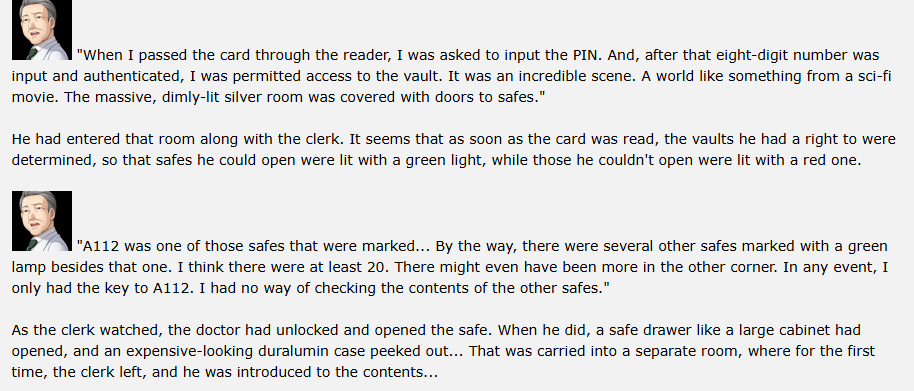
She is arranging so that their families will receive a compensation for their loss. If the siblings collaborate, the heirs will receive a payment, as promised. If they won't, well, they won't mind a huge amount of cash.
The same pin code appears in banquet written on a door in red paint just before they find George's corpse. According to the description it's supposed to open the way to a small golden land, and well, it certainly is small if you compare it to the full stack of gold bars that are worth 10 times more.
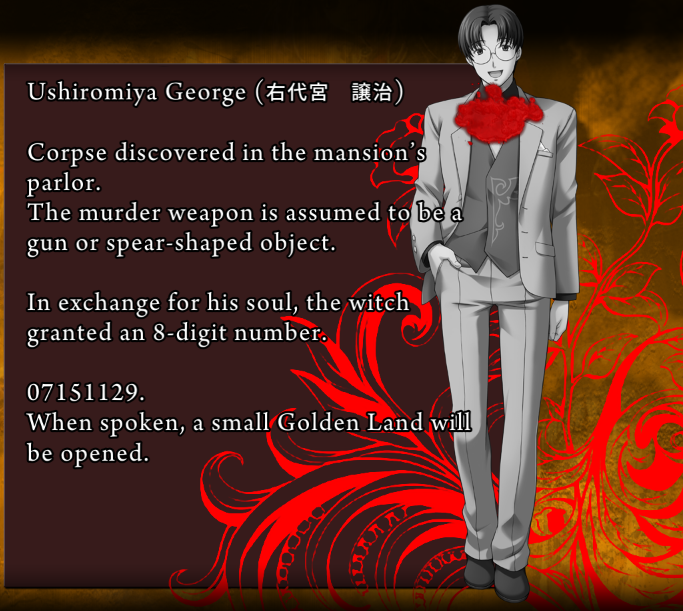
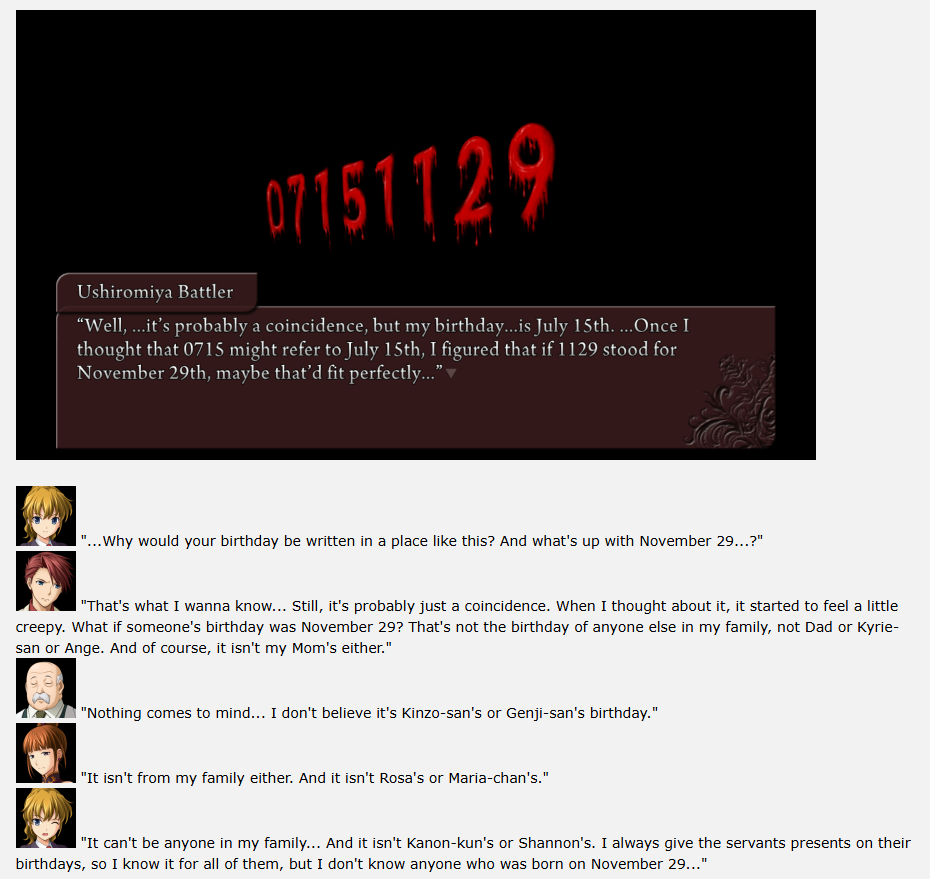
As for what the numbers mean (if anything), if the first half of the code really is based on Battler's birthday then we'll guess the second one to be X's birthday.
The bottled letters
Then, Sayo writes another even more important set of letters. They're the ones that will be released by Kawabata in the ocean after a certain date.
According to Ange, these letters are written in the same calligraphy as Beatrice's signature on the Mariage Sorciére contract and the letters with the bank information, and they contain detailed but contradicting accounts of what happened on the island. Their role is to spread the narrative of the witch after the deaths, to make sure that the magic stays "real". For this purpose they all bear the signature of Maria, since she gave the imput to Endless realization, although in practice those signatures were also written by Sayo.
The bottles all contain many plausible what-ifs of how the murders of Rokkenjima could play out on that night. In each one of them Sayo makes different alliances and reacts to different circumstances. Sometimes X plays a significant role, and other times she doesn't, but they all start from the same setup we just described.
But of course, the letters don't contain an explanation of the conspiracy, but the version of the events that the people in the island will experience.
None of the letters depicts the true events of the Rokkenjima. They were all written before the tragedy takes place.
The grand finale
Prior to the day of the conference Sayo sets up two really powerful bombs: one in Rokkenjima and one in the guesthouse, and sets them up to explode at midnight of the second day.
We already went over how Sayo and X don't plan to leave any survivors, including themselves, but it's entirely possible that they will die before the end of the second day, be it because of a mistake, an accident, or because it would help create the perfect closed room.
The bombs are a safeguard against randomness, they make sure that everyone will certainly die when the time is over, or at least they were supposed to. Of course, Eva was able to make it far enough and survive. The plan was almost perfect but not quite.
This bomb idea might sound ludicrous, and it is. It started as pretty much our only way to explain Battler's death at the end of this episode, where even though he's alone on the island he still gets killed by Beatrice, but it kind of makes more sense than initially thought.
Let's considered why the incident at Rokkenjima was perceived by the police as an accident.
We're told that Eva never commented, and at the end of Legend of the Golden witch we learn that the police was unable to identify any bodies except for a piece of Maria's jaw, let alone do any proper autopsies that would have identified the bullet wounds.
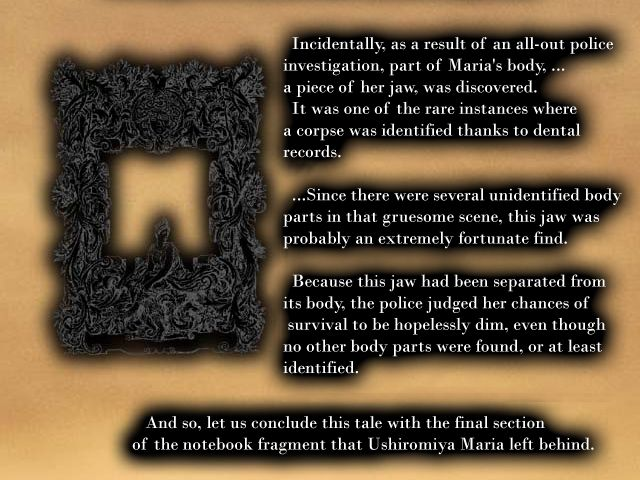
The murders were concealed by the explosion blowing up the mansion and mangling the corpses, which in the magical version is presented as them being eaten by the goat demons.
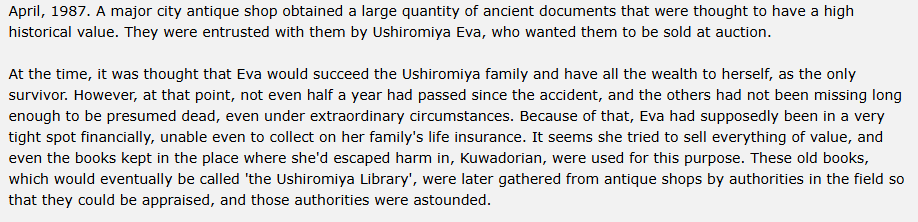
We can theorize this because there isn't a shred of evidence of the mansion still existing in the future. During Ange's trip to Rokkenjima she doesn't actually try to visit it, and when Eva sold Kinzo's books for money it's specified that they came from just Kuwadorian, not from Kinzo's study in the main building. We argue it's because those books have all gone up in flames.
So, to recap this very simple plan: On the first day, Sayo will approach Maria, and give her a letter sealed with Kinzo's crest. She'll tell Maria that an occult ceremony will occur according to the epitaph, but that by the end of it everyone will be resurrected.
"Beatrice" will then kill everyone in Rokkenjima, and a tale of the events, will be shared to the outside world. The legend of Beatrice, the witch of Rokkenjima, will be born and spread through the combined power of both Golden and Endless magic so that they may never be forgotten.
Part 3: Umineko When They Cry
Our theory, so far, might explain how the structure of the Rokkenjima murders came to be... but there is an elephant in the room that we still need to address, isn’t there?
Let’s assume we were to present it to someone playing Umineko for the first time, and expect them to reconcile it with what they’re seeing on screen. Very quickly, as they go through Legend of the Golden Witch, they would become confused and assume that the theory is completely unreliable.
First of all, they will notice that Kinzo is very much alive, and Shannon and Kanon interact with each other multiple times, even before the murders begin. Then, at the end of the first day, they would see Shannon following the golden butterflies through the mansion. Golden butterflies that, of course, we never addressed. After that, they would see the scene in which Kanon is killed in the boiler room, which seems to imply the presence of the witch Beatrice, and her magic, even more clearly.
At this point they might, as Crunter did, notice that the story has established the innocence of every single person in the main cast through internal monologues, recognizable corpses, and alibis, and assume that Umineko is throwing a curveball at them with an unreliable narrator.
Well, the definitions of Golden and Endless magic found in the theory would go a long way toward explaining how that unreliable narration works. Natsuhi’s murder and the finale in front of the portrait could be addressed in the same way. Then they would reach the credits, hear about the police finding a letter in a bottle, and begin connecting the dots about what might actually be happening, although still through a lot of confusion.
So far, so good... but then they would move on to the tea party, quickly realize that it's not just a silly extra 4th wall break, and everything would suddenly and abruptly stop making sense.
Why is there an actual witch? Why is she talking to Battler and the others? Why is everyone still alive? Where and when is this scene even taking place? What even is this?
Up to this point, our theory had been grounded in the actions and circumstances of humans. The witches were nothing more than interpretive expressions of the narratives these humans concocted among themselves.
Now, let’s leave the territory of the witch Beatrice and jump into the higher world of witches.
The classification of Witches
The definition of a witch is vague, but according to the generally accepted theory, one becomes a witch at the moment they gain possession of a power surpassing the boundaries of Humans that they can use at will.
The world, or Fragment, in which they can use their power freely is known as their territory.
Most witches cannot leave their territory at will, but those who can travel freely across the world of Fragments are called Voyagers.In the story, Bernkastel and Lambdadelta belonged to this special category.
———
~ Regarding Witches
Worlds of different fates and circumstances are called Fragments, and witches capable of crossing the ocean of endless Fragments are called Voyagers.
It is also a title used to indicate a high-order witch, and witches limited to their own territories cannot compare to their power.However, perhaps because they don’t have well-defined territories of their own, their values are ever-changing, and it’s easy for their souls to become vague and insubstantial.
It isn’t uncommon for this to result in them turning into scraps of seaweed in the Fragment ocean and fading away.
Their voyage has no destination, and you might even say they’re on a journey to escape a destination.
Witches of an even higher order than Voyagers are called Creators.
———
~ Regarding Voyagers
Creators are sacred beings who can create 1 out of the sea of nothingness. They can give birth to 1 from 0, give birth to the endless, and then return it to 0 again in a flash.
They are freed from all restrictions, and Voyagers sometimes even call them gods.In that sense, perhaps the Witch of Origins, MARIA, is a chosen girl, fated to become a Creator……
All Voyagers fear that the destination of their own journeys is becoming a Creator.
As to why they would fear advancing to the status of a higher-order being, only they themselves can comprehend the answer.
———
~ Regarding Creators
In these three tips, the author goes out of his way to classify witches into three tiers: Creators, Voyagers, and a baseline lowest category that we will call Grounded witches. These categories are an important foundation for any would-be comprehensive theory of Umineko so let's spend a few more words on them.
Grounded Witches
Grounded witches are people who have managed to exert influence over their own environment through "magic"... that is, through some form of shared belief.
For example, we previously described how the Golden magic manifested from Kinzo's obsession and the Endless magic from the servants living under it and being forced to adopt coping mechanisms.
Because of this, for the longest time Beatrice existed on Rokkenjima as a grounded witch in those two forms, influencing the events of that fragment.
But hold up, what exactly is a fragment?
Well, the tips define them as "worlds of different fates and circumstances", and the one single fragment where a grounded witch can "use their power freely" is defined as their territory, but when the higher ranked witches talk about them they imply that there is a fragment for any possible timeline, akin to the concept of a multiverse in time travel stories, or the many worlds interpretation of quantum mechanics (alas, Ryuukishi is no stranger to including tropes that originate from quantum physics in his stories, no matter how tired they become).
There's one elegant way to interpret them that allows for both readings to be true. Fragments are the same as the rest of the magic in Umineko, they're stories. Just one layer of abstraction higher.
They are made of a setting (different circumstances) and a scenario (different fates). The setting dictates what the initial state of the world is, who and what is relevant to the story, and what is physically possible. On the other hand the scenario dictates which of all the possible paths the story will take. If the author were to write about a different possibility, then that would become yet another unit in the sea of fragments.
Grounded witches are the weakest form of witch, because their influence is limited in scope to just one fragment. They may perpetuate grand narratives, but they are still characters in their own story, unable to experience anything outside of their reality.
Voyagers
Voyagers are witches who do not limit themselves to a single story. Instead, they enjoy exploring multiple fragments and spend their time interacting with them. They are readers who engage with various works and form opinions about them, but are disinterested in creation. What they seek is entertainment to stave off the poison of boredom.
This means they can be as invested in (or detached from) the joys and sufferings of the characters as they please. To them, those characters ARE works of fiction. Hence the line about their values being ever-changing.
In the first half of Umineko, we encounter two Voyager witches: Bernkastel and Lambdadelta. As far as the story is concerned, we think it's appropriate to understand them as personifications of abstract concepts.
- Bernkastel embodies miracles: the ability to achieve success in spite of overwhelming odds.
- Lambdadelta embodies certainty: the ability to achieve one’s goals through overwhelming effort.
The two of them are not, nor do they represent, active participants in any of the events we've seen so far. Neither before, during, or after the murders in Rokkenjima. Although, since we know of the existence of a certain character trough osmosis, we suspect one of them might soon come up with a little self insert.
Creators
What happens when you know not just everything that is, but everything that could be? That could get very boring indeed.
Witches of the highest order are dubbed Creators.
We believe that what Creators create are new settings with their own rules and new scenarios within them. In other words they're the writers who construct vast, sprawling narratives that become fragments of their own.
Maria is likened to a creator because she helped bring Mariage Sorcière into existence by injecting the preexisting narratives with the creative spark that gave birth to all the colorful characters populating the tea party.
The Witch of Origins, who will live for one thousand years in the future. She holds the motherly magical power to give birth to 1 from the sea of 0.
At a glance, this magical power is frail. But no matter how many times you multiply 0, you never end up with anything more than 0. However, the 1 she gave birth to will one day surpass even the heavens.
She is loyally protected by Beatrice, who understands her true worth. The two of them are members of the same alliance.
———
~ Maria's description in the future fragment.
Of witches and letters
So, we've seen 4 totally different versions of the Rokkenjima murders already, no way Beato is a grounded witch right? By the definitions given just now, she shouldn't be able to span multiple timelines and neither should the other meta characters, so what gives?
We'll answer this by examining two more "tips" released by Ryuukishi before the answer arcs.
They were presented to us by a veteran player (among some fellow witch hunters who will be thanked at the end), as she believed it would help us in our theory crafting effort.
That was quite the understatement.
Memoirs by Lady Lambdadelta
Full transcript here
In one of the two extras, Lambdadelta recounts her interactions with two individuals seeking her power of certainty.
We believe the first one is a reference to a certain character from Higurahi, Ryukishi07's previous work. It's neither subtle nor necessary to understand this next part, so we'll just skip over it.
The second one is a lot more relevant.
Someone proclaiming themselves to be a witch asks to be acknowledged by Lambdadelta, who obliges because she feels amused by this unconventional wish.
We want to argue this someone to be Sayo, calling back to how the endless magic is predicated on people reinforcing each other's shared realities.

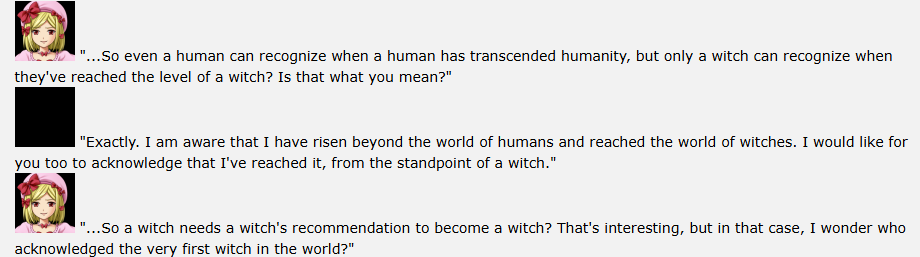
As soon as Lambda accepts, the other character, who previously didn't have their gender specified in the text, starts being gendered as a woman. This makes sense for someone who lives as both Shannon and Kanon and only settles on an identity once she is acknowledged as the witch Beatrice.
When Sayo found the gold, and later conjured her plan to murder everyone in Rokkenjima, she acquired an overwhelming certainty... and in the higher order world of witches, this manifests as Lambdadelta accepting the newly formed witch Beatrice into existence. This is the Beatrice we see debating with Battler, the one who has merged Endless and Golden into Endless realization.
Lambda then goes on about Beatrice's revolutionary magic system that she was able to establish while still in the human world. Of course, here "the human world" is to be understood as the base layer of the narrative.
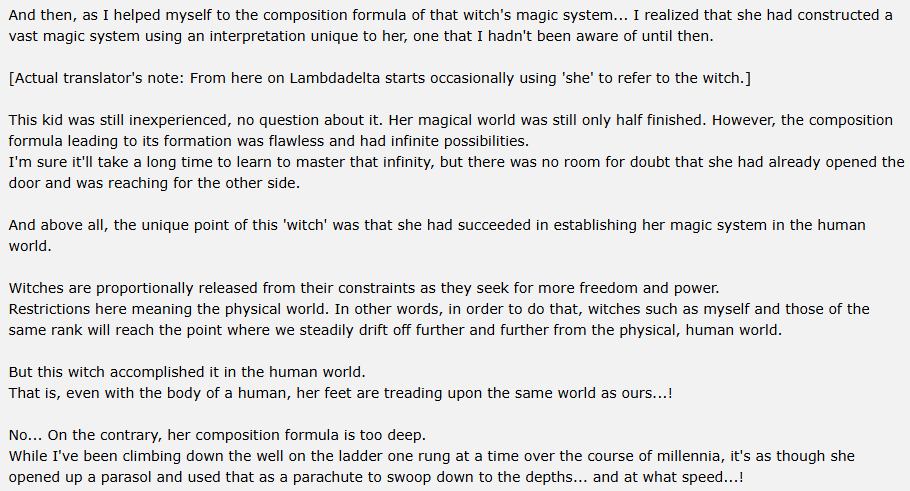
Lambdadelta materializes Beatrice in the higher world of witches because she sees the potential in this pocket magical world (the 2 days in Rokkenjima when the murders happen) as a place to confine Bernkastel, who of course is too bored to refuse and can't resist the allure of a new opponent.
Bernkastel's letter
Full transcript here
This other extra tip is a reply addressed to Bern's friend, an unnamed witch of really high ranking, who is dying of a deadly disease that at this point we can safely assume to be boredom.
In this letter Bernkastel acknowledges how she was lured into fighting a witch who is the perfect counter to her, and she discusses the rules of the games set up by Beatrice, which are the core components of Lambdadelta's gameboard enhanced by Beatrice's magical compendium.
Without getting into spoilers, this isn't the first time Ryuukishi's fans encounter the terms rule X, Y, and Z. A similar concept was featured in Higurashi, so we sort of knew what to expect.
For anyone worried about ruining Higurashi for themselves, we should stress that this meta reading of its story is mostly applied to it retroactively by Umineko and concepts like gameboards and metaphysical witches who play on them by exerting their powers on the narrative were somewhat foreign to it originally.
In short, the rules are key insights on the major (and most importantly, fixed) elements that drive the story, and now we'll take a shot at identifying them.
Rule X
As Bernkastel helself says, this isn't so difficult.

The story that always starts from June 20th is Higurashi, and by virtue of Lambdadelta's involvement one of its rules can be translated here one to one.
Rule X refers to the initial conditions of the gameboard that we went over in Part 2. In particular the terminal event of the bombs exploding at the end of the second day and killing all survivors.

Rule X is the magic of certainty. In other words it's a starting condition where all paths lead to the same conclusion.
But as we know, this rule alone is not quite airtight. It was broken once and it can be broken again. Arguably it HAS been broken again judging from Eva's survival.
To make a truly perfect gameboard you need an element of deception that makes any flaws in the plan impossible to find.
Rule Y
Bernkastel describes rule Y as the very existence of the witch Beatrice and the source of her magic. Her own original compendium.
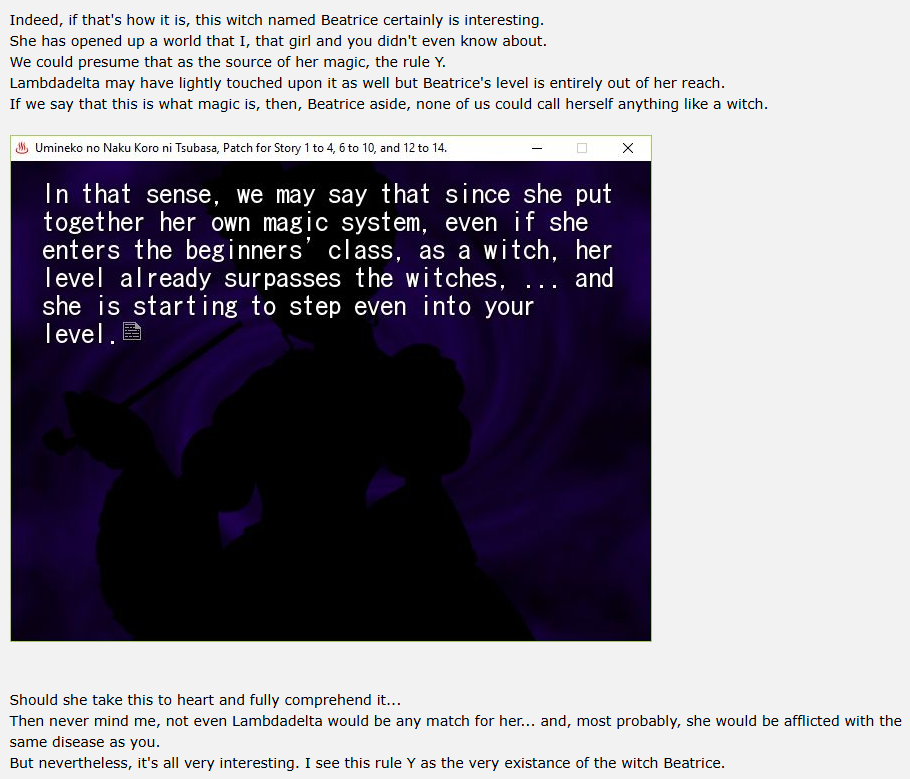
Beato's power is compared to the letter's recipient because she "opened up a world" that the voyager witches didn't know about. This refers to how, through the bottled letters, Rokkenjima became a whole new setting contained inside the world of Umineko, but nowhere to be found in the sea of fragments that Bern has spent an eternity wandering.
Inside this pocket universe, shared worldviews are portrayed as true by the narrative.
This is why magic is so often shown on screen during the games, as long as nobody denies it the narration of the witch takes precedence. This is also why we get scenes of Kinzo monologuing to himself, or if he talks to other people, it's only those who know that he's already dead. Same for Shannon and Kanon who can interact with each other on screen, both alone and in the presence of the other servants.
Rule Y is the Endless magic. The form of magic closest to the current acting Beatrice, Sayo.
But if this were everything, you could experience enough versions of the story to eventually, painstakingly, converge on a solution. It would take Bern a long time, but not forever.
Rule Z
This rule is the source of Beato's lethally bad affinity against Bernkastel, it's what makes sure that she can't eventually spend enough games fully understanding the events and reaching the truth.
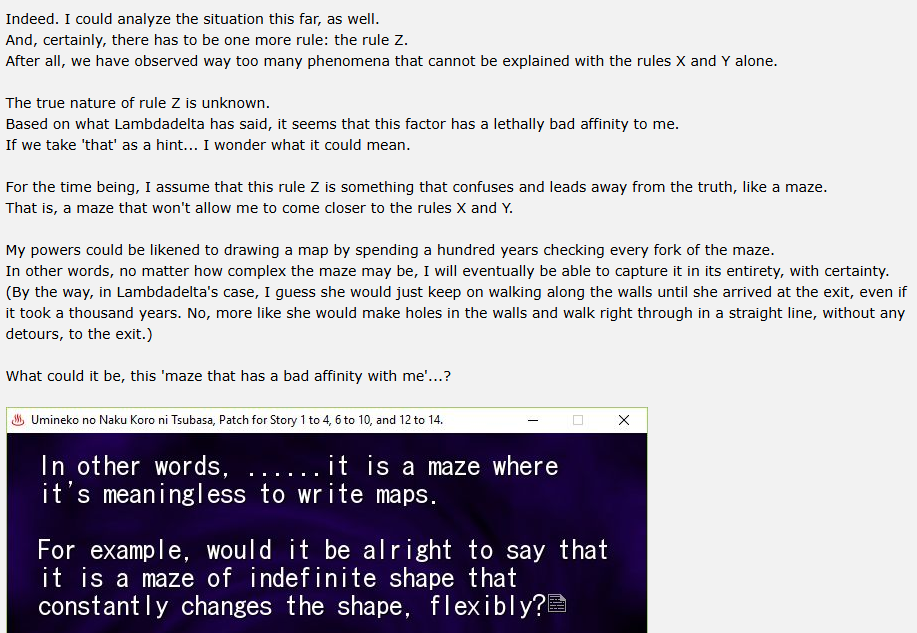
If the previous rule was able to pretend that something was real, this can actually alter the identity of people in Rokkenjima to fit the narrative.
Sayo is Kanon. Sayo is Shannon. Sayo is Beatrice. for the sake of the story, these identities are "real".
If any of those identities are discarded for the remaining of the game, those people are considered "dead".
You can see this rule in action when, by wielding the red truth, the witch is able to force certain notions such as "Kanon died in this room".
It doesn't lie, but it forces an interpretation of the facts, and it means that sometimes the wording in the red text can be used to lead astray, counting different identities as separate people.
If you're able to mask uncertain information as certain and vice versa, you have the perfect weapon to subjugate the witch of miracles.
Rule Z is the Golden magic. The power that Kinzo's legend of the witch holds over all theories and explanations in Rokkenjima.
Like it does in Endless Realization, it serves to strengthen rule Y and turn the altered reality based on mutual consent into a forceful one that refuses to be denied.
It's interesting that, after comparing Beato's power to her friend's, who's implied to be a Creator, and doubting if Voyagers should even be allowed to call themselves witches, Bernkaster says this:
Unless I can unravel this rule Z... no, basically it's exactly because I can't unravel it that Beatrice is a witch.
At this point we can say with enough credibility that Beatrice is a kind of Creator witch. She is definitely capable of creating new fragments, but she cheated her way into it by limiting her scope to a tiny slice of space and time, and she did it as a human in the world of Umineko.
For this reason, even though both of them recognize she did something incredible, she's still treated like a being of an inferior order compared to the voyager witches.
The Tea Party
Sayo writes the games to follow the rules of her magic to the letter. By doing so, she makes the narrative of the Golden and Endless Witch that emerges from them unshakable.
Captain Kawabata does his part, a fisherman recovers the first bottle containing “Legend of the Golden Witch,” and the police later takes possession of it.
Its contents are published, and the witch’s narrative sets the world ablaze.
From now on, we’ll call the fragments influenced by these letters the “future” fragments.
The legend attracts amateurs interested in solving its mysteries, witch hunters drawn to its magical narratives, and gossip seekers eager to learn about the scandalous events that transpired on Rokkenjima.
With Endless magic as the vehicle and Golden magic as the fuel, this intense interest in Rokkenjima takes shape as the tea party: a limbo where people debate the events of the tragedy. The tea party parallels the game in the higher world of witches, but Beatrice’s opponent here isn’t Bernkastel. It’s Battler Ushiromiya, the ideal rival for the witch, and the person who was supposed to stop the tragedy by remembering his forgotten promise.
The main takeaway is that the tea party is not a time loop endlessly repeating over those two days. It takes place in hindsight, looking back on a mystery whose outcome has already been decided, even though the path to that outcome remains obscured. So, when we follow Ange in Alliance, we don’t travel to the future, we simply stop looking back for a while and see the present.
The tea party is populated through Endless Realization. This explains how Battler can be there even though he’s already dead: he is a character in this narrative, distinct both from the real life Battler and from the Battler portrayed in the letters. The same applies to Beato. Although she can largely be identified with Sayo, she also incorporates elements of all the Beatrices described in Part 1.
To understand the structure of this world and give it a proper name, we need to examine the concepts of Hell, Purgatory, and Paradise introduced throughout the question arcs.
Hell
In Umineko, as in classical Western tradition, Hell is a place of torment where the dead are forced to suffer over and over.
It represents the failure state of the games described in the bottled letters: in Beatrice’s words, “everybody died and went to the golden land". She presents this outcome as the only happiness left to them, as suggested from this sentence in the last of Battler’s profiles at the end of Alliance.
Hell could also plausibly be read as the gameboard itself, where we explore all the ways these people might have died.
Purgatory
If Purgatory is the place between Hell and Paradise where souls endure trials before reaching the latter, then Umineko’s Purgatory is the tea party itself. It's not a surprise then that it is the name given to the setting of the tea party at the end of Legend.
For this reason, we’ll refer to the tea party where Battler and Beatrice debate as “Purgatory” from now on, just as we’ve been using “the higher world of witches” to refer to the plane of the Voyagers.
Paradise
Umineko keeps returning to one question: what is Beatrice’s actual win condition? What is her Paradise?
We’re told repeatedly that she wants Battler to believe in her magic, but that goal can be interpreted in many ways. It’s a dilemma that troubles Purgatory's Beato as well.
Her goal can’t simply be to make Battler admit defeat. He already did that in Turn, and the games continued. Nor can it be to make him accept a false reality where everyone is happy in the Golden Land and there’s no conflict left to resolve. That almost happened at the end of Banquet, but just before Ange arrived, Beatrice seemed like she was about to end the farce herself, likely because she realized it wasn’t the answer.
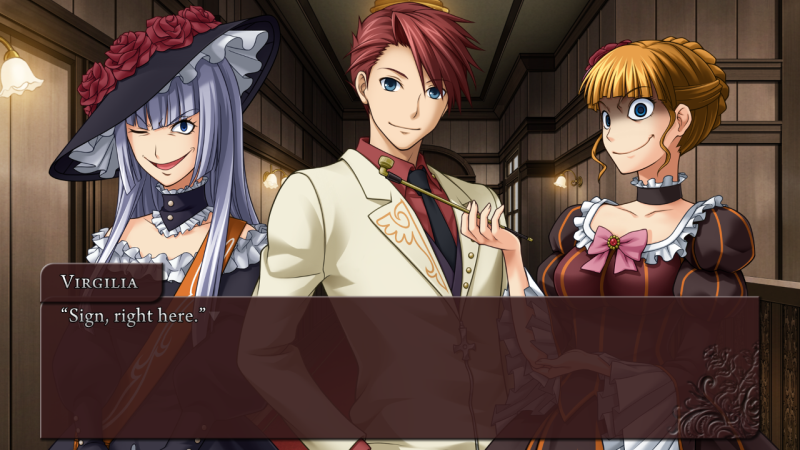
Sayo’s deepest wish is something else.
When she wrote the letters, the Paradise she and X hoped for may have been the genuine happiness that the people of Rokkenjima never reached: a world where Battler remembers his promise and the tragedy never happens.
That wish can no longer be fulfilled, Beato’s “Paradise” has instead become a world where the pain of Rokkenjima is understood and acknowledged, and where those who suffered finally receive some measure of true understanding.
The games Beato plays against Battler are difficult, but they aren’t unwinnable. She seems to be leading him toward an understanding of what happened on Rokkenjima, allowing him to reach it on his own.
Lambdadelta, in her place, might construct something so opaque that it couldn’t be solved using the available information.
Many of Beato’s red truths become crucial hints. She repeatedly accepts losses she could have avoided, and, through Virgilia, she even helps explain how Endless magic works.
Battler is Beato’s opponent because his failure to remember his sin embodies the lack of understanding she wants to overcome. His personality also makes him the perfect skeptic, though we’re sure Bernkastel cries herself to sleep knowing she got stuck with the incompetent one when she could have had Kyrie instead.
This also helps explain why Beato can’t simply tell him the truth. Sayo wrote the letters from a place of hopelessness, and the story deliberately emphasizes that Battler must understand his sin for himself.
We like to imagine this condition mirrored in the higher world of witches, with Lambdadelta imposing a rule on Beatrice as insurance. Like Ange, Beatrice cannot reveal her true name to Battler. He has to figure it out on his own.
Despite her creator-adjacent powers inside her cage, Beatrice is still a temporary witch. She needs Lambda’s approval, which means maintaining the strength of will that fuels the power of certainty. By Alliance of the Golden Witch, that will has been badly shaken.
At the end of the episode, Beato despairs at the apparent impossibility of her task. She no longer wants to fight or keep subjecting people to the “hell” of her Golden Land. She seems willing to be forgotten and die without reaching her Paradise but Battler gives her a reason to keep going.
It’s no coincidence that the question she leaves him with is “Who am I?”
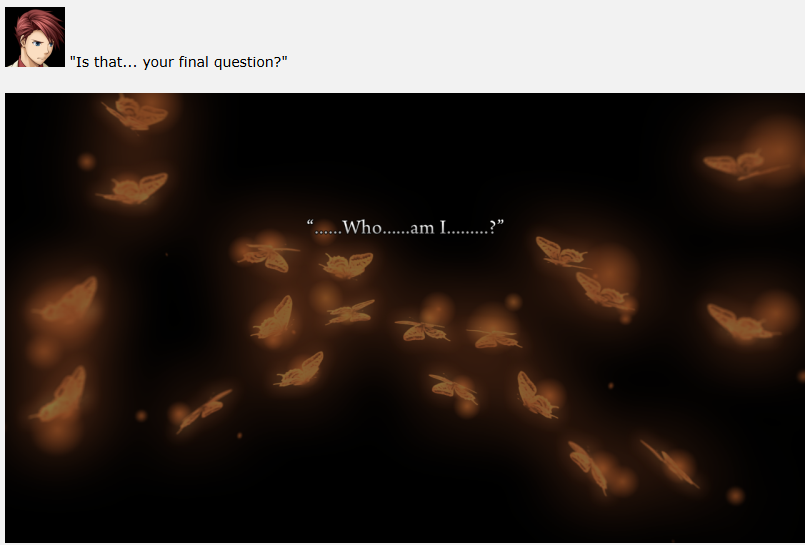
Here, Beatrice finally acknowledges what she wants. If Battler can solve the riddle, if he can understand and accept her, he will be invited to the first true tea party.

The tea party of those who are not humans
We've been writing around it this whole time, but why exactly do witches exist? Why does the higher level of magic exist? Much like the tea party is a place in which people discuss the Bottled Letters, The ??? Tea party is a place in which the characters of the visual novel discuss it's content. We've been calling it, up to now, the real world of witches.
Can we go any higher?
Remember the recipient of Bernkastel's letter? Her friend?
We believe they are not just any creator, but the creator of "Umineko When They Cry". After all this is a game written by someone, and the mechanics of it are established to work like a magical compendium in a consistent way.
But who could Ryuukishi 07's self insert possibly be?
This would have been the start of a tangent trying to identify this character, we flirted with the idea of the friend being Maria, her being the writer of Umineko would be a way to put a nice thematic ribbon on the whole story. But that's not really possible, because we kinda know the answer... or at least we think we do?
This sucks, but it is what it is
We, Crunter and Hound, the writers, don't live in a bubble. We live in a world in which sometimes people talk about Umineko, and we can't always dodge the information.
We spent a loooong time writing these theories, years. This is mostly because real life got in the way, we found jobs, and we truly didn't have time to go in depth. And, I, Crunter, was adamant about taking this project seriously, I didn't want to create something half baked just because there wasn't enough time to tackle it, I was stubborn. And I felt like we could do it, we could solve Umineko.
In some periods there wouldn't be an opportunity to dedicate time to the theories, and we just decided to left them on pause, for months. That's why it took so long, most of the time was us not being able to dedicate ourselves to this project.
In retrospect, I don't know if I would insist for being this thorough again, but in some ways it's also a very cherished experience.
But, information seeps in, especially on such a long time frame, and it's not always possible to avoid.
This will not be the last time we reached a conclusion with the help of outside information. I'm also sure that, sometimes, ideas seeped in through osmosis without us even realizing it. Those cases are impossible to identify. Whenever we can, however, it's fair to point them out.
So, what happened? You see, I, Crunter, watched Higurashi Gou and Sotsu, and in those series there is a character, Eua, who people would constantly point out as a cameo from Umineko.
Seeing how people talked about her made me connect the dots, she sounds lik the in universe creator of Umineko. Truly a double curse, not only it may have spoiled us an element of Umineko, but I also watched two seasons of the terrible Higurashi sequel in the process.
Regardless, we tank the hit and move forward.
The higherarchy of fiction visualized
That was a lot to take in wasn't it? To mark the end of part 3, here's a visual recap of all the meta narratives that make up this visual novel and the ways they intersect.
Part 4: The first three games
The reason we may have glossed over many details so far is that, as you might know or not, this is actually our fourth and last Umineko theory.
Previously, we combed through the first three episodes, painstakingly analyzing the games presented and trying to wrap our heads around the mysteries. We wanted the final chapter to stand on its own, which is why we've already spent a word count equivalent to the longest of the three laying out everything we believe we know about Umineko in general.
In this part, we'll briefly sum up the main takeaways from the previous theories, but first we need to establish an important distinction between "games" and "episodes".
The "games" are Sayo's original bottled letters. Each is a story that begins with the setup of the gameboard and aims to convince the reader of the magical version of events while being based on a mundane one. By the time we experience them, the games are static. They were written twelve years ago and cannot change to challenge Battler.
The "episodes" are duels between Battler and Beatrice in the tea party, built around the "games". Of course, they're also episodes of the visual novel Umineko When They Cry, authored by its creator. Importantly, Beato can perform her magic over them, so certain things that weren't part of the original games may be shown to Battler, or to whoever is spectating.
We're not sure this distinction is always consistent in Umineko, but we need to make it to illustrate some elements of the games more clearly.
Legend of the Golden Witch
This is our original theory for Legend of the Golden Witch. We'll link it here for whoever is interested, although reading it back makes us cringe somewhat, given the mistakes and the fact that the writing is much worse
Theory for Legend of the Golden witch
~ published on 18/04/2025
Ironically, given that we've just distinguished between games and episodes, Legend of the Golden Witch is the one episode that coincides almost exactly with the game it depicts. This is because, before the first bottle surfaced, the conversation surrounding Rokkenjima was strictly materialistic. People treated the unsolved case as a murder mystery and wouldn't assume from the outset that magic was involved.
So, let's present our reconstruction.
- There are 17 people on Rokkenjima: Krauss, Natsuhi, Eva, Hideyoshi, Rudolph, Kyrie, Rosa, Jessica, George, Maria, Battler, Genji, Kumasawa, Gohda, Nanjo, Sayo and X.
- During the day, Sayo contacts Eva, Hideyoshi and Rudolph to invite them to participate in the plan. Rudolph refuses and is forced to stay silent under threat. Eva and Hideyoshi accept, and Sayo lets them in on the fact that Kinzo is dead and tells them about her multiple identities.
- When Sayo goes to the guesthouse to tell the cousins that dinner is ready, she stops in the rose garden to give Maria the letter and the umbrella. As in all the following games, the letter is meant to alert the family to the possibility of a 19th person and kick-start the magical narrative. It's not enough to kill everybody, the point is to make a story out of it.
- Rudolph, knowing something fishy is going on, warns Battler and Kyrie that he might be killed that night.
- X verifies that Battler doesn't remember his promise. Distraught, she commits suicide.
- George proposes to Shannon, who intentionally avoids answering. She pockets the ring to it use later.
- Later that night, while Rudolph, Kyrie, Rosa and Krauss are still arguing, the servants call Gohda to the scene. Sayo then shoots all five of them with her winchester, loaded with 4+1 bullets.
- Nobody other than Sayo actually kills anyone in Legend, since Genji, Kumasawa, and Nanjo are not killers.
- Kinzo's body, which was hidden in the boiler room, is burned in the incinerator. Later in the day the stench will fill the mansion, prompting its discovery.
- With Eva and Hideyoshi's help, the servants spend the night creating the crime scene in the garden storehouse. They paint the magic circle and disfigure the bodies, then dress X as Shannon and put the ring George gave Sayo on her finger. They place the corpse where her face can't be seen clearly.
- Since Shannon is a manufactured identity, for the purposes of the red truth this counts as Shannon having died (Rule Z).
- Before morning, they splatter some blood on the doorknob of Natsuhi's room.
- Eva also leaves the receipt in the gap of the door of Kinzo's study before morning, to set Natsuhi up later.
- By morning, Kumasawa hasn't quite finished cleaning the blood in the parlor, as someone later notices.
- Kanon (Sayo) acts as though he's reporting the magic circle to Genji so the others will follow them and discover the crime scene. Importantly, Eva and Hideyoshi are adamant that none of the children enter the shed, especially that they don't get close to Shannon's corpse. If George were allowed to look at her, he might notice she's someone else.
- Natsuhi goes up to Kinzo's study and pretends to talk to him. We see a conversation between the two of them because of Rule Y.
- Eva tries to frame Natsuhi with the receipt trick, but it doesn't work. Thanks, Battler.
- In the kitchen, Maria tells Battler that Beatrice is right there with them. Of course, she's referring to Sayo.
- Eva and Hideyoshi feel secure in their deal with Sayo, so they retire to their room.
- Sayo kills them, then creates the appearance of a closed room by pretending, as Kanon, to find the door closed in an implausible way when they discover the bodies. She and the servants paint the magic symbol, mutilate the bodies and plant the stakes in their heads. There are no witnesses to this scene other than the servants, so the narration is able to offuscate it. The room was never confirmed in red to be a closed room, so it isn't one.
- With very little time left before the others arrive, Kanon can only leave a letter with "Praise my name" on it instead of a longer one.
- Sayo rushes to the boiler room, splatters a bag of fake blood on her chest, leaves the stake on the floor and pretends Kanon has been stabbed. Nanjo fakes an attempt at first aid and later declares Kanon dead. The red truth never claims that Kanon was dead, and his corpse isn't mentioned again, so Sayo could have got up and slipped away at any point.
- All the survivors hide in the study. This time, they've prepared a letter for Genji to keep in his pocket and place on the table when nobody is looking. Maria finds it, and Natsuhi correctly guesses that one of the servants might have put it there. She then kicks them out.
- Maria and the servants go to the parlor, and Sayo shows up after reloading her gun. She tells Maria to turn away and sing, and Maria complies.
- Nanjo and Kumasawa have underestimated Sayo's madness and don't expect her to turn against them. They beg for their lives, but she kills them anyway. Genji, who unlike them is fully bought in Kinzo's narrative, is killed too.
- Sayo lures everyone out by calling the phone in Kinzo's study, and they take the bait.
- When they reach the parlor, they see the crime scene. Natsuhi finds a letter telling her to go to the portrait room alone, and, believing she's the only armed person, she agrees.
- Natsuhi and Sayo shoot at each other in front of the portrait, but only Natsuhi dies because her rifle is loaded with blanks.
- The cousins find Sayo in front of Natsuhi's body, but it's already midnight and the bombs explode. Game over.
In this reconstruction, the identities of all the corpses are accounted for. X's presence is explained by her temporarily assuming the role of Shannon. After all, Kanon is right there in the gardening shed.
It's important to note that the body in the shed, identified as "Shannon", appears in a scene where literally everyone except Kumasawa is present, whether alive or dead. We find it very difficult to argue that Kumasawa was disguising herself as Shannon there. An old lady shouldn't be able to pass easily for a young woman, even in a shadowy corner with her face hidden.
This matters because it brings the number of humans on Rokkenjima back up to 17. Apart from details like this, it wouldn't be difficult to argue that X isn't needed for the story to work, but the need for a 17th person is hidden in the gaps of every episode in several places.
At the end of Legend, we discover that the bottled letter has been found by the police. Meanwhile in Purgatory, we see the characters engaging in something like a book club discussion of the events of Legend of the Golden Witch, which is explicitly called an episode. Then Beatrice appears and shows magic to everyone. Again, Battler serves as a parallel to the process of trying to understand what happened, because according to Sayo, he's the person who should have understood it in the first place. This is Sayo's Endless magic.
In the ??? tea party, Bernkastel has a spat with Beato, then she gives hints to Battler and by extension to the people trying to solve the mysteries. This is framed to look like she is talking to the reader, after all, the players of the visual novel are trying to understand what happened just as much as the people in the future are.
Turn of the Golden Witch
This is our original theory for Turn of the Golden Witch.
Theory for Turn of the Golden witch
~ published on 28/08/2025
This one is an improvement on Legend, but it's still fairly contrived in places. There are also a few important differences between it and our current outline, both in what we left out and in what we've changed our minds about.
When the bottled letter of Legend of the Golden Witch was found, all the people looking for clues to solve the mystery of Rokkenjima were instead given a magical explanation, and that shaped the conversation around it. Later, the second bottle was retrieved, sparking a new round of discussion in which, unlike the first time, the public was already primed to expect magic.
As a result, we're shown a whole prologue in which Beato, in the tea party, backs up her argument against Bernkastel and us readers. This isn't part of the game described in the letter, it takes place in the magical framework surrounding the discussions.
As evidence, while talking to Shannon, Beato even references Bern's private conversation with Battler in Legend's ??? tea party. It's a cheeky jab showing that she was listening.
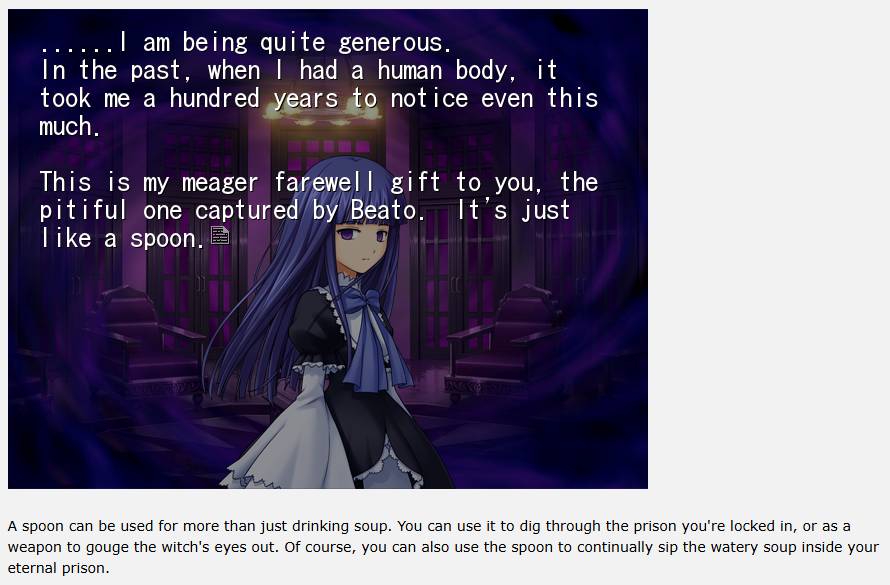
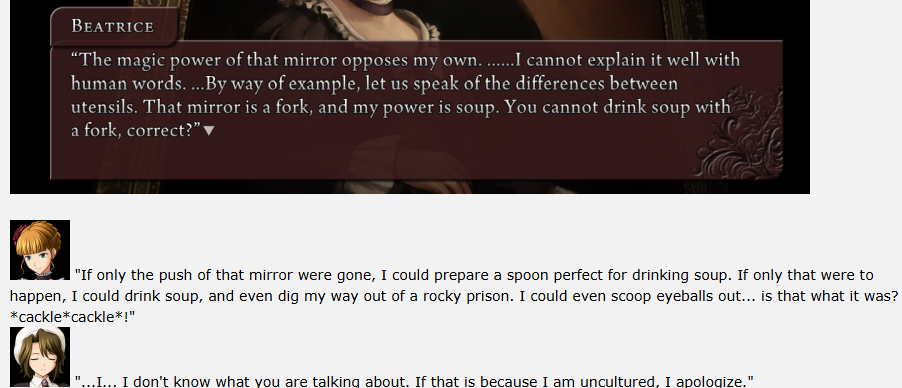
As explained in part 2, the date with George, the school festival and the discussions between Shannon, Kanon and Beatrice flesh out the magical side of the story and establish Sayo's motives.
The preparations of the chessboard are complete, and discussion of the game can begin. This won't be like the clean game of Legend, because Endless and Golden magic have come into effect. The audience's expectations now "color" the events being described and influence what is "real", so the tea party turns purple and is engulfed by the island's magic. This explains all the magical scenes we see in Turn and afterwards.
Let's present our reconstruction.
- In this game, X doesn't die early on. She actively helps with Sayo's schemes.
- In the rose garden, X appears before Maria and Rosa. Maria sees someone who looks exactly like Beatrice, so she can only assume that's who she is.
- Maria closes her eyes, and X simply swaps her rose for another one. Rosa is shaken not because she witnessed magic, as the narration claims, but because she initially mistakes X for 0 Beatrice, who died so long ago.
- X gives each of them a letter. Maria's envelope has the key sealed inside it, but Rosa's contains a proposal to join the plan. X knows Rosa will read the letter as soon as possible, giving her the opportunity to join X and Sayo. If she does, she'll be spared in the chapel that night.
- Kyrie sees X, or rather, X allows Kyrie to see her. This is a ploy to establish the magical narrative. Showing someone who looks like Beatrice helps the aura of magic around the island grow. It also helps establish that someone is occupying the VIP room.
- During the conference, late in the evening, Sayo, Genji and Kumasawa lure the adults to the chapel by telling them Beatrice wants to talk to them. Either there or earlier, Rosa tells X and Sayo that she accepts the plan.
- X comes to them with a proposal that will settle the inheritance problem if they all agree to acknowledge her. This is why we see all of them admitting that she's a witch out of context, but that is just a ploy to buy some time until the others are ready.
- Sayo arrives on the scene and shoots all the siblings and their significant others except Rosa. Then they spend the night preparing the Halloween scene. Sayo leaves the letter challenging everyone at the chapel crime scene. They place three gold ingots there to make the mystery of the witch more believable.
- The chapel door was never locked that night, which completely nullifies the red truth concerning it. In the morning, Rosa, Nanjo, Sayo, Kumasawa, X and Genji stage a fake discovery in which Rosa pretends to open it with the key in Maria's envelope. Gohda and the others fall for it.
- Jessica immediately runs to the VIP room in a fit of rage. There she finds a letter Sayo left, worded so it would work no matter which cousin found it.
- Sayo, currently in the role of Kanon, enters the room after Jessica and takes the opportunity to stab her in the back. Then she locks the room with her own master key and puts on Shannon's clothes. By Rule Z, Kanon being "dead" refers to his persona being discarded. This explains the red.
- Rosa goes to Kinzo's study, where she meets Sayo and the others. They use the opportunity to review the plan and settle the details of what they'll do next. When Rosa returns, she lies about having seen Kinzo.
- Nobody has been killed in the servants' room. Nanjo and Kumasawa hide away, and Sayo closes the room as she leaves, locking the master key inside.
- Gohda is now equally terrified of the conspirators and Rosa, so he complies and tells everyone the story about Kanon coming back to life and attacking them. With Rosa on their side, the conspirators wouldn't have much to fear from her gun, even if it were loaded.
- George and the servants leave. Sayo lures everyone to Natsuhi's room on the pretext of setting up a scene. Then she kills everyone and herself. She hides the gun by shooting from a position where it will fall out of sight when she drops it. Rosa assumes Sayo is only pretending to be dead, which is why she grabs Battler's shoulder when he checks the body.
- Genji regroups with Kumasawa and Nanjo, but he's loyal to X and Sayo, so he attacks and kills them as instructed. That's what his throwing a knife at the butterfly means. Their bodies are found and retrieved.
- Rosa then kicks Battler out of the parlor by pretending to find a piece of paper she placed there herself. She feeds him to the wolves to keep herself and Maria safe.
- Battler gets drunk, and Genji offers to bring him to Kinzo's study, where X Beatrice is waiting. She wants to speak with him before they die at midnight, to tell him the truth. They talk for a while.
- Just before midnight, after realizing that the perpetrators have turned on their accomplices, Rosa tries to grab the gold and run away with Maria. She doesn't make it in time and is caught in the explosion.
- The mansion blows up, killing Battler, Genji, X, Rosa and Maria.
It should be noted that whenever we see magic on screen, everyone involved is either complicit or dead by the end of the scene.
The bottled letter describes scenes such as Beato killing Jessica and Kanon, "Kanon" killing Nanjo and Kumasawa, or Shannon, George and Gohda fleeing the chapel (a CLOSED chapel, mind you!).
On the other hand, things like Beatrice sneering at the ghosts of the dead and all the flashy light sabers are manufactured by the narrator for Bernkastel's benefit in the ??? tea party. It's endless magic giving a new framing to the events being described.
Another theme that first emerges in this episode is the magical narrative's tendency to absolve the humans, all more or less culpable in their own ways, by placing all the blame on the witch. Rosa gets a heroic scene at the end, where she cares deeply about Maria and runs away with her. Shannon and Kanon are both given heroic sacrifices. Beatrice is the only one treated as guilty.
This strongly resembles the story in Maria's diary about one child in the class having to suffer so that 19 others can be saved.
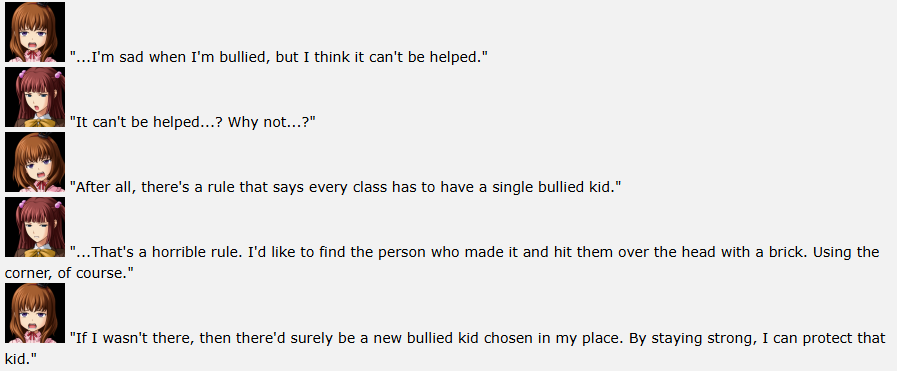
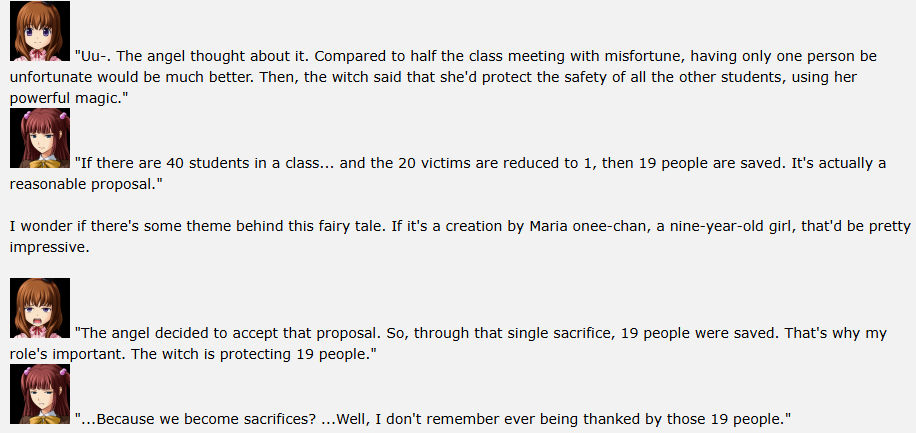
Even though Sayo killed everybody, she's trying to sanitize their memory, not condemn it. This is consistent with our earlier claim that what Beatrice in Purgatory wants is for Battler, and by extension the audience, to understand all of the suffering in Rokkenjima, and her actions in this episode support that theory.
She introduces the red truth, a tool that will prove more helpful than harmful to the human side, and leaves plenty of gaps for Battler to practice debating against it, knowing full well that he can't deny her existence yet. Despite this, she pushes her aggression too far, and Battler is still crushed. This definitely isn't the outcome she wants, so she'll adjust her strategy in the following game.
Banquet of the Golden Witch
After the retrieval the letters, the legend of the witch has crystallized in the minds of the witch hunters. There's only one problem: as far as we know, only two bottled letters were found. We'll set that aside. After all, Battler and Beato are playing a third game. Maybe another letter was found but never made public, maybe we as an audience aren't told about it, or maybe speculation about the events of Rokkenjima has become a self-sustaining process, allowing the tea party to continue on its own.
This is our original theory, and it basically still works.
Theory for Banquet of the Golden Witch
~ published on 21/01/2026
There's enough wiggle room in Banquet for multiple working solutions, but in our opinion, this reconstruction works best.
- Beatrice meets Maria in the rose garden and gives her the usual letter.
- Like in Legend, Eva and Hideyoshi are Sayo's two accomplices.
- On the first night, all the conspirators except Nanjo are on their way to kill everyone in the parlor, but for some reason a fight breaks out among them. All of them are killed except for Sayo.
- She then lures out and kills Gohda, sets up the six locked rooms over the course of the night, dresses as Kanon, turns on the incinerator containing Kinzo's corpse, and pretends to be dead in the chapel. X is dressed as Shannon. Here too, we're not allowed to see her face clearly. Kanon and Shannon are dead as identities, so the red is still valid.
- As the red truth says, everyone in the closed rooms is a victim. The word "victim" is simply being used more broadly and doesn't refer only to the murders currently taking place.
- Sayo convinces or threatens Nanjo into keeping up with the plan. He's instrumental because he can vouch for "Kanon" being dead. Once the bodies are discovered, Sayo only has to wait for everyone to leave before walking out of the chapel.
- Eva is left in an awkward position. Now that the servants are dead, the plan she agreed to seems to have fallen apart, so she keeps a low profile for the moment. She might suspect Sayo is alive, since she later supports Rosa's theory that the servants were only pretending to be dead.
- Eva solves the epitaph as shown, but Rosa arrives soon after, and they strike a deal. Eva could take this opportunity to stop siding with Sayo, but she's concerned that her sister won't fully back her up, and she doesn't want to share the gold. She lets her greed take control.
- When she gets the chance, Eva goes out through the window to kill Rosa and Maria, but her gun fires a blank. Assuming she missed, she resorts to physical violence to kill them. Hideyoshi stays in the room to provide her with an alibi.
- Kyrie deduces what's going on from the cigarettes in Eva's room and decides to lure Hideyoshi out to the mansion to confront him with Rudolph. They can't actually shoot each other because they have no live ammunition. Instead, they're shot by Sayo, whom everyone believes to be dead. Eva is very worried about the situation by this point, but assumes the three got into a gunfight with one another.
- George meets Nanjo in the corridor as Nanjo heads downstairs. There, Nanjo and Eva attack Natsuhi and Krauss with ropes and quietly strangle them. Eva then takes the bodies outside to the rose garden.
- While Eva is busy with that, Sayo's voice lures George to the window. He leans out, and Nanjo pushes him down, locking the window from the inside.
- Sayo keeps her promise and writes the red numbers of the combination on the parlor's door.
- Eva panics because George has disappeared, and eventually they find his body in the parlor. In the confusion, Eva fires the rifle next to Jessica. Although the blank can't kill her, the blast is close enough to burn and blind her.
- Sayo kills Nanjo, then threatens Jessica. She switches to acting as Kanon and "leads" Jessica to a safe room. There's no practical reason to do this, but for Sayo, the performance itself is the reason.
- Eva and Battler run through the mansion looking for the killer. Time runs out, and everyone left inside dies in the explosion.
After being far too hard on Battler during Turn of the Golden Witch, Beatrice in Purgatory realizes that beating him into submission will never win her the game.
Now that the witch narrative has taken hold in the present, she can craft fake scenes on a larger scale and summon Ronove and Virgilia, two manifestations of her magic. Initially, she takes advantage of Battler's struggle to deny magic and flaunts the fantastical scenes to show him how appealing they would be if they were real. We can see from his shocked reaction that the fantasy scenes in Turn weren't actually shown to Battler, only to the audience.
At the same time, Beato makes some obvious blunders. She restricts the number of people on Rokkenjima and makes it clear that the battle scene couldn't have happened, nudging Battler toward an understanding of how her Endless magic works. Unfortunately, in trying to reinvigorate him, she cedes too much ground and weakens her own narrative. To fix this, she consults Virgilia, and they decide to pivot to the northern wind and sun strategy.
To begin a redemption arc, she needs a new character, someone convenient to take all the blame for the time being. Eva Beatrice, the representation of Eva solving the epitaph, fills that role. It's likely that the real Eva never found the gold in the "real" timeline, but what shapes events in Purgatory is the narrative, not the truth. Eva Beatrice isn't just a puppet, either. She's a wildcard with her own agency, another independent character created by Endless Realization, just like Battler, Beato, Ronove and Virgilia.
Eva Beatrice is sponsored by Lambdadelta. As a character Eva has a fairly high affinity to the concept of certainty and she uses the same gameboard Lambda granted Beato in the first place.
After this, Beato plays her part and eventually defeats Eva Beatrice by denying her. She knows her own identity and the answers to Rokkenjima's mysteries. While Battler covers his ears, she tells Eva Beatrice who she is and what she did. Afterwards, Battler himself validates her as Beatrice again.
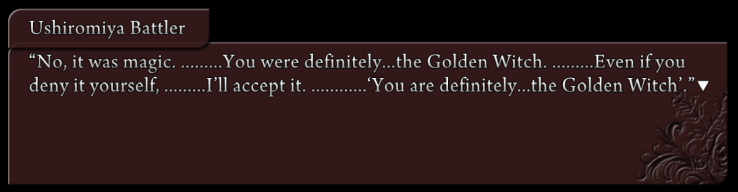
This line is especially intriguing because Beato is surprised to see herself with her usual appearance. Having just denied magic, she probably perceived herself as Sayo rather than Beatrice at that moment.

At this point, she could close the game. She didn't just "pretend" to redeem herself, she "performed" it, so by the logic of her endless magic, that should be enough to make it real. In this scenario, the tea party would end with Eva as the culprit, which is what most people seem to believe anyway. But as we said, Beato can't accept a win without earning Battler's understanding, so she throws the game at the end, just before Bernkastel's interference makes that choice irrelevant.
Part 5: Alliance of the golden witch
The Future Present
Over the course of the first 3 games, Bernkastel has come to the realization that the deck is stacked too much against Battler for one of the games to naturally end in their favor, so she decides to look for a new pawn.
Ange makes for a perfect target. First off, she is alive in the future where the narrative of the tea party keeps on being written from outside of the game board. She is also very strongly motivated to uncover what happened in Rokkenjima during those two days. Lastly, she is for all intents and purposes, the modern "Beatrice".
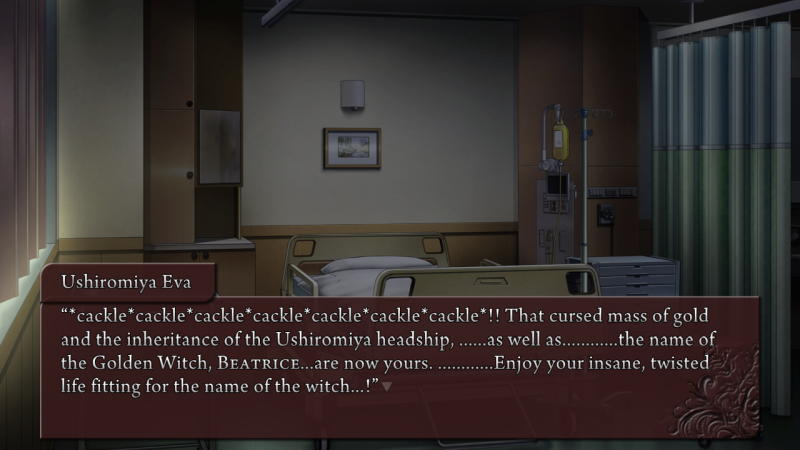
Ange is familiar with the Endless magic from her stime spent with Sayo and Maria, and she inherited the title of Golden witch from Eva, making her the heir of Endless Realization.
In a sense, Eva herself was already Sayo's successor, not because of any notable affinity to the endless Branch, but because, with Banquet, she became the de facto culprit in the public opinion, and since that narrative took sail it almost became "true". But we digress.
Ange showing up in Purgatory soon after falling from the roof of a skyscraper is the reason why we used to think that she might have actually died here, but then we would need to explain why and how her Journey in the future fragment is all fabricated.

Instead we have a different explanation. You see, surviving that fall is very unlikely, but it's not statistically impossible. All Bernkastel had to do was find a fragment of the future in which Ange doesn't die.
She then convinces her to join the game by vaguely hinting at the possibility of saving somebody from the victims, or more precisely, she thinks that through some miracle it might just be possible to save one person without specifying who in particular.
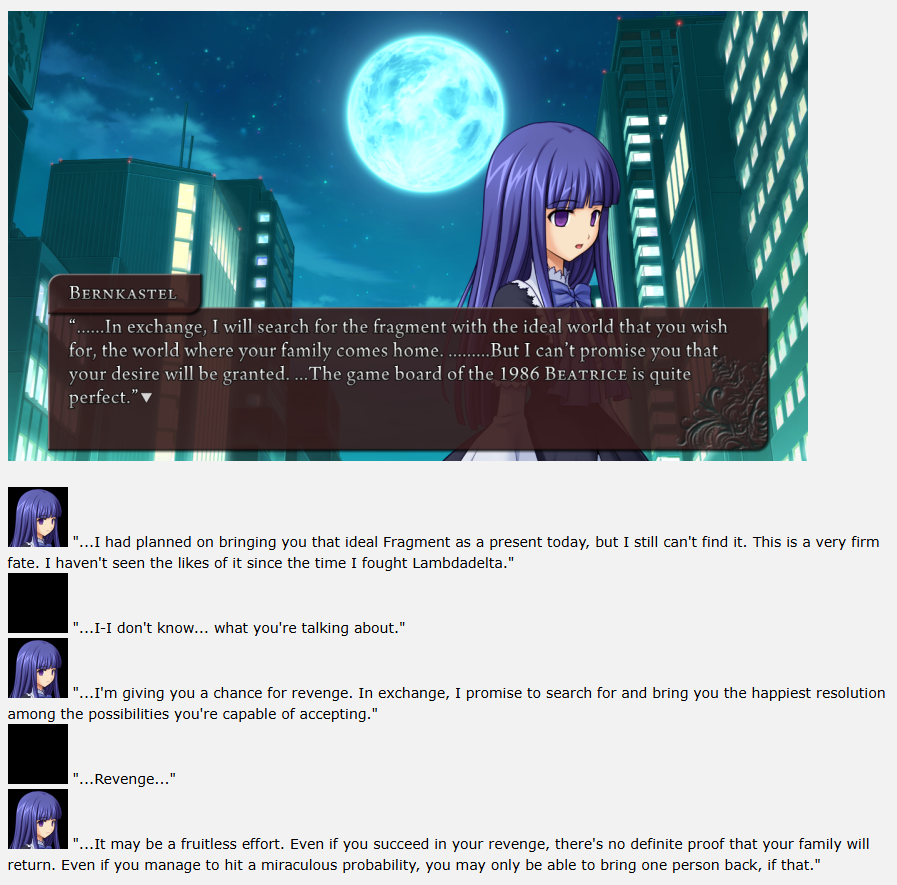
Of course, Ange doesn't fully realize that everyone she will save will not be there in her future.
The actual game board is made up of Sayo's letters and other sources from that time, so she can can only interact with the Purgatory layer, the one actually located in her own time.
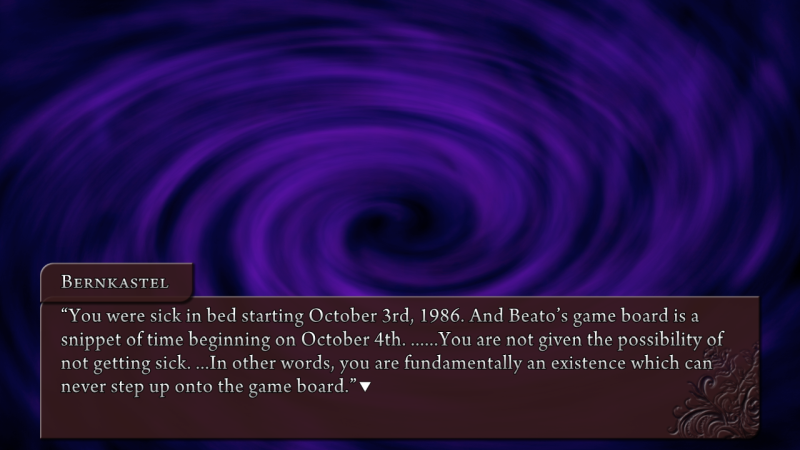
Ange has spent all of her life since the tragedy suffering, first she's been abused by Eva, then she's been abused in Saint Lucia, and finally, she is now subjected to an inheritance struggle she wants no part in.
Much like Maria, Sayo and X before her, every time she couldn't cope with reality she took refuge in magic by reading Maria's diary, and this gave her some comfort.
Of course, just like in their cases, it can only have a partial effect on reality at best. Maria, Sakutarou, and the stakes of Purgatory can't save her from bullying and they certainly can't resurrect her family, so once again, Ange becomes disillusioned with magic.
After surviving that traumatic fall, she decides to give it another shot and begins her investigation. Amakusa is one of Okonogi's old colleagues from his 'previous job', and he's tasked with protecting her from the Sumadera family and Kyrie's sister.
Of course Okonogi has an interest in Eva's heir not falling in someone else's hands. After all, Ange might legally own that money, but he is in charge of the company with the power to wield it.
Most of the insights Ange gains over the course of her trip have already been discussed at length in the previous chapters. She meets with professor Ootsuki, who tells her about the letters with the games, and allows her to understand that the person writing them is "Beatrice".
Then she meets with the sons of Nanjo and Kumasawa, where she learns about the letters with the code to the vault, and that some of the relatives of the victims, including herself, had received a large sum of money.
When Ange finally arrives in Rokkenjima, she attempts to reach Kuwadorian, but she is intercepted by Kasumi and her goons. The fact that Eva Beatrice appears in this scene, overlayed over Kasumi, prompted us to seriously consider the possibility that she was actually present on the island during Banquet of the Golden witch, but that just doesn't fit the rest of the theory on too many levels.
There's no need to take the association so literally, when the text already gives a satisfying interpretation. Ange is abstracting the concept of the black witch from Eva the human, and this was the most effective visual shorthand to convey that.
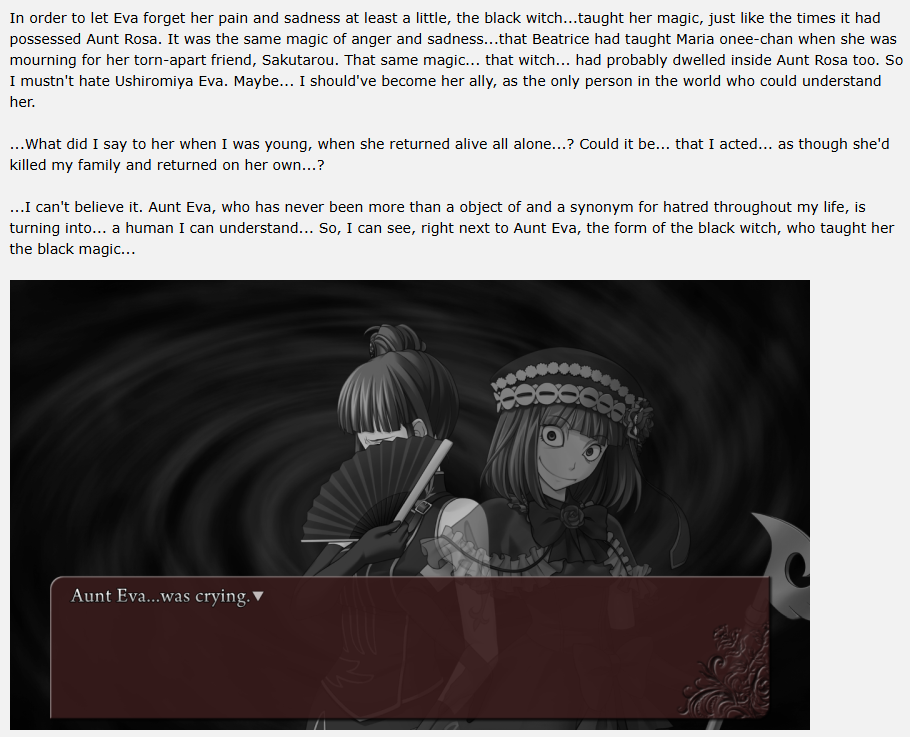
What Ange, as the Golden and Endless witch, aka the narration, interprets as the seven stakes killing the attackers, is nothing but a re-framing of Amakusa sniping them from afar. It's Beato's oldest trick from as early as Turn of the Golden Witch.
As of the end of Alliance we imagine that Ange is still in Rokkenjima heading towards Kuwadorian.
The fourth game
Meanwhile, in our metaphysical view of Purgatory, Bernkastel acknowledges ANGE and allows her to join the game alongside Battler.

However, ANGE is bound by a rule imposed by Lambdadelta, the same rule that binds Sayo, our other Beatrice: she isn't allowed to reveal her name to Battler. This rule is an expression of the game’s central theme of self-discovery. Battler can't simply be handed all the answers. The conflict is meant to lead him to a new understanding.
ANGE suffers most from this restriction. She cannot reunite with her brother, even on a meta level, until the game against Beatrice is won.
As soon as the game begins, something seems unusual... Kyrie appears to know why Krauss refuses to show Kinzo to anyone. One could infer that she had suspected the truth all along and that her suspicions simply never came to light in the previous game. We suggest, instead, that they were confirmed after she struck a deal with a certain someone.
In this scenario, Sayo recruits Kyrie by promising a safe future for her daughter. Together, they make sure Krauss is pushed into a corner, and that gives Sayo the perfect opportunity to recruit him as well. If the truth were discovered, Krauss would go to jail and his family would be ruined. Besides, he has nowhere near the amount of money his siblings are demanding so he really needs all the help he can get.
With Krauss on board, recruiting Gohda becomes a trivial matter, so the full list of Sayo’s collaborators in this game is therefore: Genji, Kumasawa, Nanjo, Gohda, Kyrie, Krauss, and X. Sayo gives Maria the letter and umbrella, but this time with the added framing that they came from Kinzo.
The siblings give Krauss an ultimatum: if he does not accept their proposal by 22:00, they will force their way into Kinzo’s study. When the time arrives Krauss, pretends to accept the deal in order to buy some time, and all the siblings agree to testify that they indeed saw Kinzo. It's because of this framing that, from our perspective in Purgatory, we are actually shown Kinzo coming down and interacting with everybody.
Sayo and the other servants then arrive with rifles and kill Natsuhi, Rudolf, Hideyoshi, Eva, and Rosa. From this point on, everyone except the four cousins is in on the plan, and we can see that every scene involving them is altered in some way compared to reality. They interact with dead people and characters who don't exist, and nobody bats an eye at seeing Kanon and Shannon together at the same time.
While the conspirators turn on the incinerator containing Kinzo’s body, Kumasawa and Gohda run to the guesthouse as instructed. There, they tell the cousins a fabricated story about some fantastical and inexplicable events in the parlor.
The cousins receive another call instructing them to lock Gohda and Kumasawa in the gardening storehouse and leave the key with them. Sayo then shoots Gohda and Kumasawa through the window.
After Krauss and Kanon tell Jessica to head to her room for the test, Sayo kills Krauss, he has played his part. This is around the time when in Purgatory, Battler is shown the death flag battle against the goats. Kyrie of course knew they would betray him, and she suspects she is next.
At this point, Sayo no longer needs the identity of Kanon, so she discards it. This is Kanon’s “death” under the red truth, he is the ninth person to die.
George is instructed by Shannon to wait in the rose garden.
When given the choice between sacrificing yourself, your lover, or everyone else, George chooses the third option and attacks Gaap, but hold on a second...
Who the hell is Gaap?
One of the 72 Great Demons. Also Beatrice's friend. When a magician demands it, she grants the ability of instantaneous movement.
She uses this extraordinary power for playing pranks, mostly. Her specialty is hiding keys and bags during busy mornings.
However, in the context of closed room mysteries, this power becomes an ultimate weapon that can easily strike a finishing blow. Her queen bee strikes are likely to pierce any and all detectives, forcing them to surrender.
———
~ Gaap
She's extremely hard to place because she's sort of thrown in there at the end without the same unmistakable hints that let us to identify Ronove as Genji and Virgilia as Kumasawa.
We have two possible candidates, none of them are particularly convincing but here they are.
X Beatrice
We've established that she only looks like Beatrice, so she could reasonably have a different persona, and the blonde hair and blue eyes work for her just as well as they do for Jessica. Plus, every time we have mentioned her in the reconstruction, it was as part of a trick to create a closed room.
Although X already shows up in this episode with her appearance from Turn, we can argue that it is just her human design, like how Genji and Ronove coexist in different scenes. The main point against this reading, which almost invalidates it, is that even after X excuses herself from the game board, Gaap is still around none the wiser.
Nanjo
Right... we can explain.
Nanjo is the last of the usual group of conspirators who doesn't have a counterpart, and while he doesn't especially resemble Gaap, or have a friendship with Sayo, he is even more instrumental to the many closed room mysteries than X. The whole point of Gaap is that she is useful to Beatrice because she creates closed rooms with her magic, as Maria points out in Legend of the Golden Witch.
It certainly wouldn't be the first time in history an old man roleplays as a young woman through a layer of abstraction, would it?
We believe in Gaanjo.
Regardless of her identity, she confronts George and then shoots him dead.
Assuming Jessica is not Gaap, she also gets to her designated location and is faced with Genji (whose family name is Ronoue), but he's behaving very unlike himself so she's more than a little confused.
Jessica chooses to sacrifice herself, and with the promise that no one else will be killed, she is made to describe a magical scene to Battler on the phone. She also tells him about George’s death, which she saw from the window.
The moment Battler closes the call, Genji shoots Jessica with a shotgun and locks her room as he leaves.
The same thing happens with Kyrie soon after. She too is forced to lie to Battler, killed and left in a locked room. She knew betrayal was likely, but she went along with it because she believed Battler would be spared if she complied, or at least her daughter would at least receive the inheritance.
Battler receives one final call from X, who tells him to meet her at the entrance of the mansion, while Maria is told to go to the chapel.
X gives battler the letter and confronts him about his sin from 6 years ago, hoping it will help him remember his promise, but it doesn't.
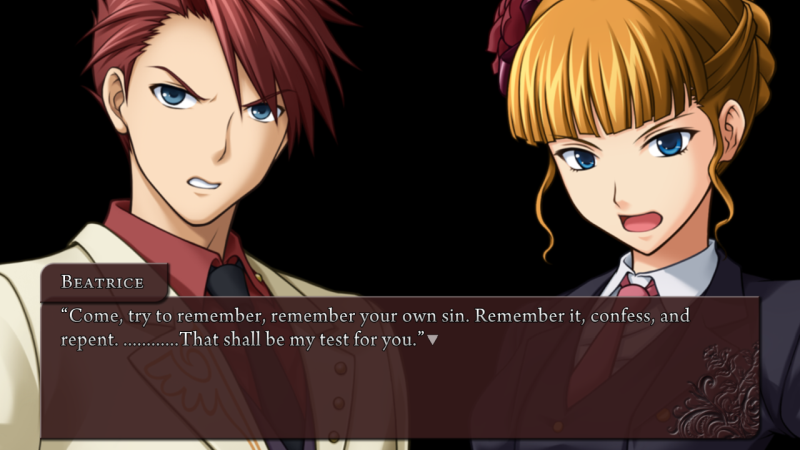
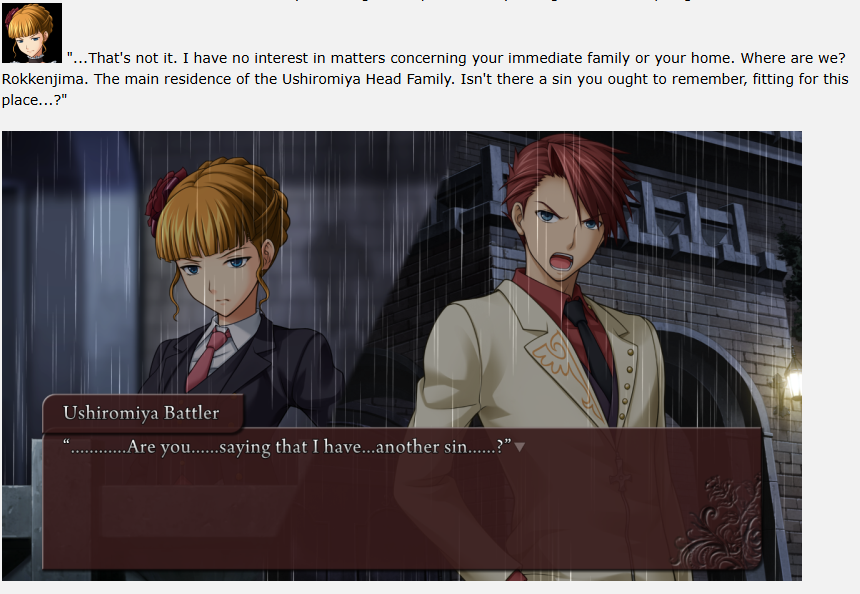
In this scene X is performing as the witch Beatrice, but that is not her name, her identity, or what Battler knew her as. That's why the red truth insists that Beatrice is not involved in the sin.
{Battler} Six years ago, no person called Beatrice existed for me.
———
The sin I am now demanding that you remember is not between Ushiromiya Battler and Beatrice.
Crushed by this realization, X gives up, and tells him to go to the chapel. She then leaves and “removes herself from the gameboard” by killing herself in a hidden place, possibly the secret passage leading to Kuwadorian. This is shown in the Purgatory layer as the Beatrice in regular clothes disappearing while the one in witch clothes takes over. This scene is the greatest reason why X and Sayo need to be separate people.
To finish the job, Sayo kills Nanjo and Genji, arranges the bodies in a place where Battler will find them, and goes to speak with Maria. She gives her the letter, and Maria chooses herself. She is made to drink the poison, thinking it's only going to be temporary, before everyone is resurrected.
Sayo leaves a pair of master keys in front of the chapel and moves Maria’s body next to Rosa’s, before killing herself next to Nanjo and Krauss.
Battler is left alone in a mansion with a ticking time bomb, He spends an entire day wandering but he's unable to understand what happened before the explosion forces him out of this gameboard. That's how “Beatrice” kills him, despite everyone else already being dead.
In Purgatory, Beatrice is disillusioned with Battler because he can't remember his sin even now. When it becomes clear that he cannot answer, she quits the game and denies his existence by declaring in red that he is not Asumu’s son.
There is one hint hidden away in Banquet that makes this riddle trivial to solve, while Kyrie is fighting one of the sevens stakes, she mentions that she and Battler's mother gave birth on the same day and that her son died.
With this red truth we can come to the conclusion that Asumu was actually the one who had a miscarriage.
Either Rudolf, Asumu, or both of them, secretly switched the newborns so that their marriage would be saved. Kyrie never discovered the switch, and we can't begin to guess how Beatrice learned of it, but it's a very clean solution.
Distraught, Beatrice retreats to her lonely Golden Land with Maria. ANGE brings her back by using a crucial piece of information she just received a couple chapters earlier.
The last time we saw her before this point she had just found something in the room of Kawabata's grandchild, something shocking to her and her imaginary friends but completely mundane to the captain and Amakusa.
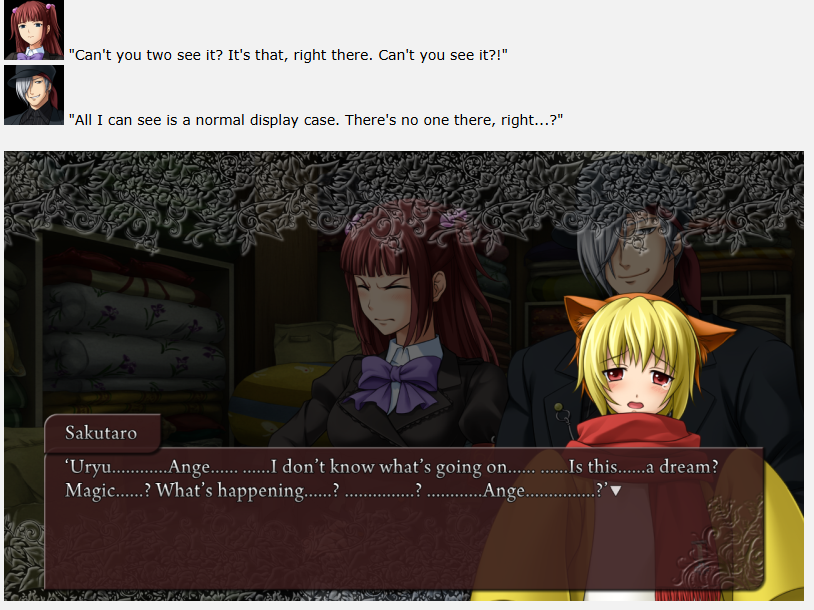
What she sees there is another Sakutaro. Perhaps Rosa made more after the first, hoping to turn the design into part of her business, or maybe she felt bad about breaking the original one and was going to give it to Maria as an apology. In any case, after the tragedy, it found its way to this room just to be discovered at the perfect moment. Truly the kind of astronomical coincidence that the witch of miracles specializes in.
Beatrice was unable to bring Sakutaro back to life because both Sayo and Maria believed he was a one of a kind, but now that Ange has proof of the contrary, the golden land is broken. The fact that ANGE can bring information from the present into Purgatory was already shown when Mammon recognized her, and is further proof that the tea party is contemporary with Ange's time.
Lambdadelta and Bernkastel shackle Beatrice to the gameboard to force her to finish the game, but Battler is still devastated, so to bring him back in the fight as well, ANGE reveals her identity. This breaks the rule she agreed to with Lambdadelta and removes her from Purgatory.
At first Beato tries to throw the game, but Battler sees how weak her attempt is. Forced to try harder, she arms herself with new red truths and puts up a more convincing front for the second round, but she is still trying to lose. At the end, however, she decides to try just one more time and barely hangs on to life by a single mystery. The "Who am I?" riddle.
Battler exits the game board and the question arcs conclude on the way to the fifth game.
Was Beato's despair all an act? Lambda certainly seems to believe so, after all the solutions Battler gave to the mysteries were completely wrong. Perhaps we have fallen for the witch's trick once again, but we believe it was genuine. Which forces us to reflect on the question that started it all.
Magic or Human tricks?
Is magic in Umineko real? In a way, one could argue that no, it's just someone writing a visual novel. And isn't that devoid of magic? Sure. In that case, "The lord of the rings" doesn't have any magic either, it's just a creation of Tolkien.
We don't think that's a satisfying answer anymore, so what you've read so far is a distinctly magical theory.
If the original goal of this game was to defeat the witch by denying all magic, in that we have failed spectacularly, after all we spent countless words describing the intricacies of Umineko's magical compendium before ever addressing the games themselves.
While coming up with ways to deny Beatrice at every turn, we have partially graduated from Voyager to Creator, and we have ended up writing a piece of narrative validating her own.
If this was a game between us and her, she would have crushed us, we would have been defeated by our own hands.
Let's say we switched sides, if we were right the witch wins, and it's our victory as well. We can even sponsor her by recognizing her existence, isn't that nice. After all, we are beings of an even higher order. If we made significant mistakes, the stalemate will continue and Beatrice will be left alone to fend for herself. Maybe we can hope in Battler failing as hard as one can, but as things are, the story leaves little to no hope for her.
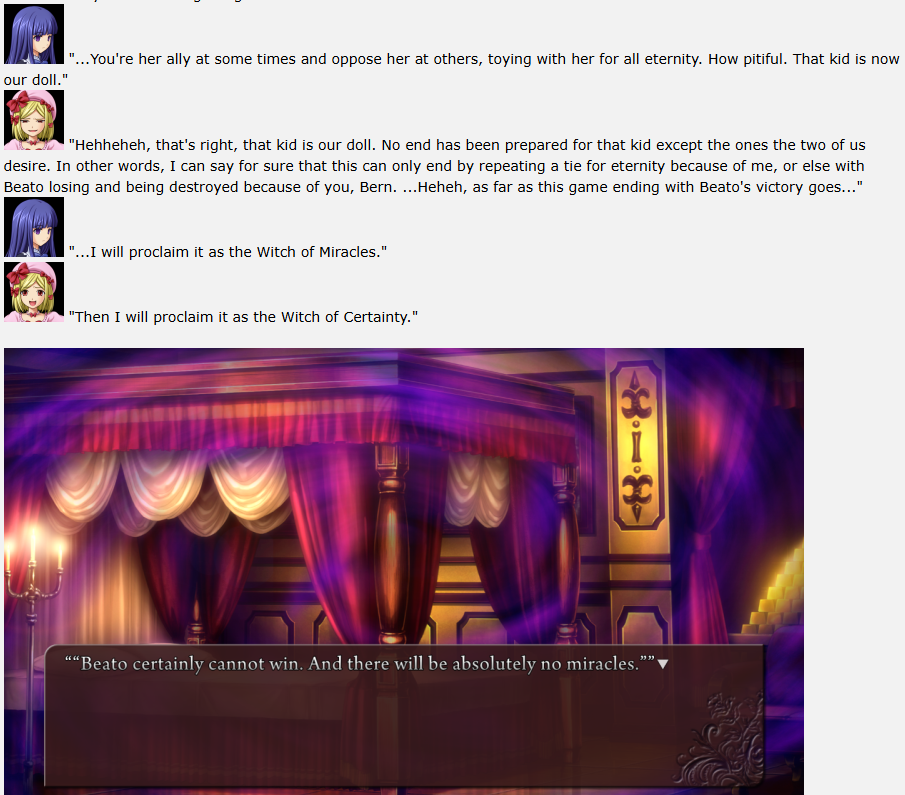
Part 6: Loose ends and final thoughts
16 or 17 People on Rokkenjima?
After having finally made it to the end, we think it's a good idea to gather all the reasons we think X Beatrice is an unavoidable part of our theory in one place. In many ways, the story would work better with only 16 people on Rokkenjima. X’s character is barely explored, even considering all our speculations, and many solutions become more elegant if we cross one person off the list. For instance, in Alliance, Battler can only find only 16 bodies.
Yet several clues prevent us from doing so.
First, the police believe that 18 people died on Rokkenjima. They believe Kinzo was still alive and do not know that Kanon and Shannon are the same person. But we later learn that Eva escaped the island alive. That leaves one person missing from the count, and a record of an extra person traveling to Rokkenjima would help account for them.
Second, the body in the gardening shed in Legend of the Golden Witch is difficult to explain, unless we make the blind assumption that it was a mannequin or Kumasawa in disguise.
Third, in a similar fashion, the six closed rooms and the red truths surrounding them leave us with one extra corpse not accounted for.
Fourth, Kyrie in Turn and Battler in Alliance both see someone who looks like the painting of Beatrice. Kyrie might have been in on the plan in Turn, but we have no other indication that she was, and in Alliance Battler sees X as well. He was some distance away, and it was raining heavily, but the scene never suggests that he could not see her clearly.
Fifth, having established that this character physically exists in the gameboard, it could still be argued that Sayo plays her role, but not only it would be unreasonable to add an extra identity for her to juggle, she also doesn't particularly resemble the witch to the point that changing her hair would be enough to fool Kyrie. In fact, putting their full sprites side by side we can see the author going out of his way to give them two distinctive patterns on opposite legs, almost to signal that it can't be the same person.
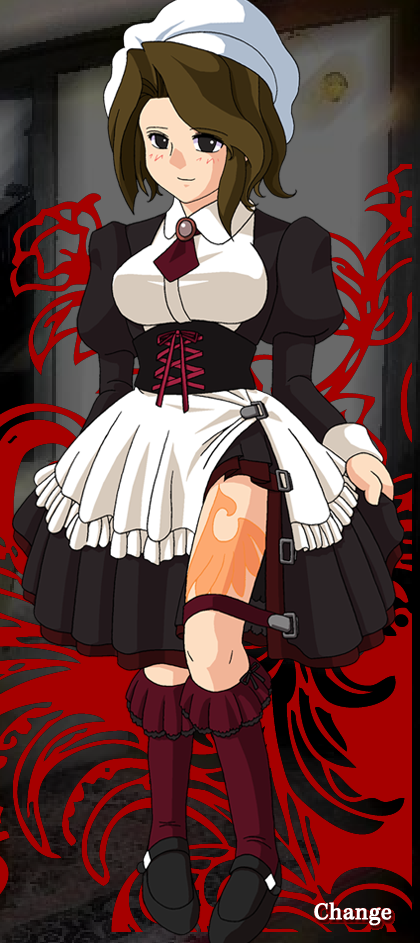
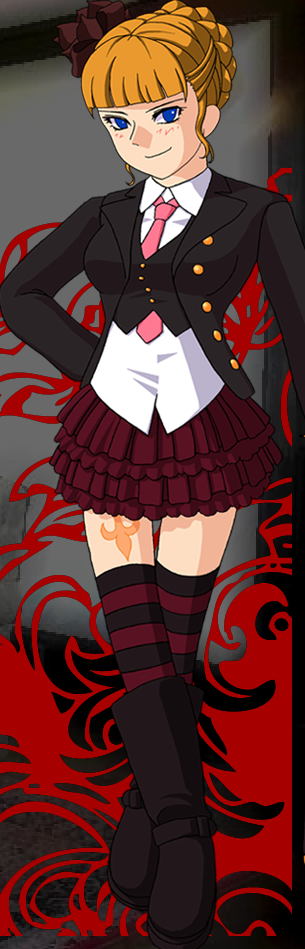
Sixth, why does Genji bring Battler to Kinzo’s study near the end of Turn of the golden witch? He says he wants to tell Battler the truth, but why could he not do that where Battler already was? The obvious possibility is that someone is waiting in the study. Sayo’s body has a conspicuous bullet wound to the head, so that person would have to be someone else: X.
Seventh, again, this entire scene.
But for fun and for the sake of argument, let's try to construct a scenario in which X doesn't exist:
- For some reason, the police took a long time to find Eva. Therefore, 18 people are believed to be dead in Rokkenjima at the end of Legend.
- Kumasawa hid in a corner disguised as Shannon, and Sayo accepted the considerable risk this posed.
- After being falsely discovered dead in Banquet, Sayo stealthy ran to the chapel and disguised herself as the dead Kanon.
- Kyrie lied to the other adults in Turn, and Battler could not see Sayo clearly in Alliance because of the rain.
- The differences between Shannon’s and Beatrice’s character designs were merely an unfortunate stylistic choice.
- Genji brought Battler to Kinzo’s study simply to show him Kinzo’s corpse.
We find the uncertainty of a mysterious 17th person more convincing than some of these explanations. If we are right, then X is Beatrice's trump card mentioned by Lambdadelta, whether or not she intends to use it. She is kept hidden from the reader to set up a subtle but perceptible trick.
One Person to Save
When Bernkastel meets Ange, she hints at the remote possibility of saving at most one person. We wanted to give this line a serious look before dismissing it as a bluff. So who could that person be?
As far as we can tell, every family member has a good reason not to pretend to be dead. None of the children appears to be involved in a conspiracy. The adults have their lives to return to, Rudolf and Kyrie have a daughter waiting for them. Gohda has no reason to fake his death, he wants to do respectable work and live his life. Kumasawa and Nanjo also have children and a lot of money waiting for them back home. That only leaves Sayo and Genji.
Here's an idea: Sayo is still alive and hiding for some reason. She is the one sending out the message bottles to this day. In this hypothesis, the tea party is more than a metaphorical discussion of the tragedy, it represents the relationship between the story she released into the world and the public consensus forming around it.
We can identify two main problems with this interpretation:
Firstly, why would Sayo hide? Perhaps to solidify the narrative, but that feels like a weak explanation.
And secondly, what does the narrative gain from her survival? It would be different if Battler were alive too and the tea party represented a real debate between them, but if Battler is alive, why has he not returned to Ange? We would have to assume Sayo is keeping him prisoner or something similar. To be fair, that is roughly what Purgatory is, but the whole theory feels like wishful thinking intended to give one line more significance than it has.
Battler’s Promise
So. We have avoided this question like the plague all throughout the theory, but let's stop beating around the bush. What is Battler's promise?
The story only talks about a sin, but we narrowed it down to a broken promise because of how often Beatrice remarks that witches, unlike humans, keep their promises.
We have a halfway decent guess, but it owes a great deal to how the overall community treats Battler, so it's influenced by outside factors. We would most definitely not have guessed this by ourselves, in fact we almost finalized the theory without this section before some outside input made us revise it.
So, Battler made a promise to X, then forgot about it completely, leaving her desperate. People often make fun of him in a way that resembles teasing someone for treating a romantic partner badly. He also has a reputation for flirting with women carelessly, as the scene with Jessica near the beginning of Banquet shows.
Through George, the story places great weight on marriage proposals. And in Legend of the Golden Witch, the corpse who we believe to be X is found with a wedding ring on her finger. Viewed through this lens, the scene of Battler's test becomes outright tragicomical. Especially because it leads directly into her attempting to make him identify his sin.
Did Battler promise X that he would marry her, only to forget and then return to Rokkenjima 6 years later? Perhaps. They even mention Battler coming back on a white horse at one point.

But wait! This is Shannon, which means this is Sayo. That makes the long-shot possibility that Sayo and X are the same person a little more believable, though still not believable enough to overcome the mountain of other evidence. It's more likely that Battler would simply say this to every girl he met back then, or that Sayo is directly poking at him with a remark that completely flies over his head, related to X.
This is our best guess, but we are not entirely convinced by it. The marriage proposal may be a stretch. Perhaps the promise was something closer to “I will save you,” though that is too broad to count as a strong guess. Still, the wedding ring gives the marriage interpretation some thematic weight, and for now, we are satisfied with it. It sure is better than nothing.
Special thanks
We would like to thank all the people who read our theories and were interested in what we had to say. In particular, thanks to Mallorean for linking us the extra tips released before the Answer Arcs, and for being the first person willing to listen to our ramblings; and to Chairs, who read Umineko at our suggestion and at the time of publishing has long since finished it.
Extra special thanks to Grande Nero for checking the grammar and syntax of our theories.
And thanks to you who has read all of this! As much as we did this mostly for ourselves, it's heartwarming to see people engage with something we put so much effort into.